I’ve spent years watching franchise networks struggle with a question that seems simple on the surface but reveals a fundamental misunderstanding about how distributed brands actually work.
The question is: Does each franchise location need its own local marketing system to attract more customers?
The answer depends on whether you think marketing is a creativity problem or a management problem.
The Outdated Model Is Still Running
When you buy a franchise, you expect head office to handle the marketing. That’s the deal. You pay royalties, they build the brand, you execute locally.
That model worked when national media dominated. Television, radio, print, billboards. Head office could buy reach at scale and every location benefited from the halo effect.
But that era is over.
Everything that can be done at the national level has been done. The returns on centralized brand awareness campaigns have diminished to the point where they no longer justify the investment for most franchise networks.
Meanwhile, franchisees are being asked constantly about local sponsorships, community donations, and neighbourhood partnerships. These opportunities matter more than another billboard on the highway. But most franchise systems have no structured way to evaluate, execute, or measure these local initiatives.
The result is chaos disguised as autonomy.
The Real Cost of No System
Most franchise networks overspend by 40 to 70 percent without realizing it. The problem is not carelessness. The problem is that they have never unified the work into a system.
When each location operates independently, you get:
Duplicated vendor relationships. Every location negotiates its own deals, pays different rates, and receives inconsistent service levels.
Inconsistent brand execution. Some locations run professional campaigns. Others post sporadically on social media and wonder why nothing happens.
No visibility into what works. Head office cannot see which tactics drive results because there is no common measurement framework.
Wasted marketing dollars. Without a system to track performance across locations, you cannot identify and eliminate underperforming spend.
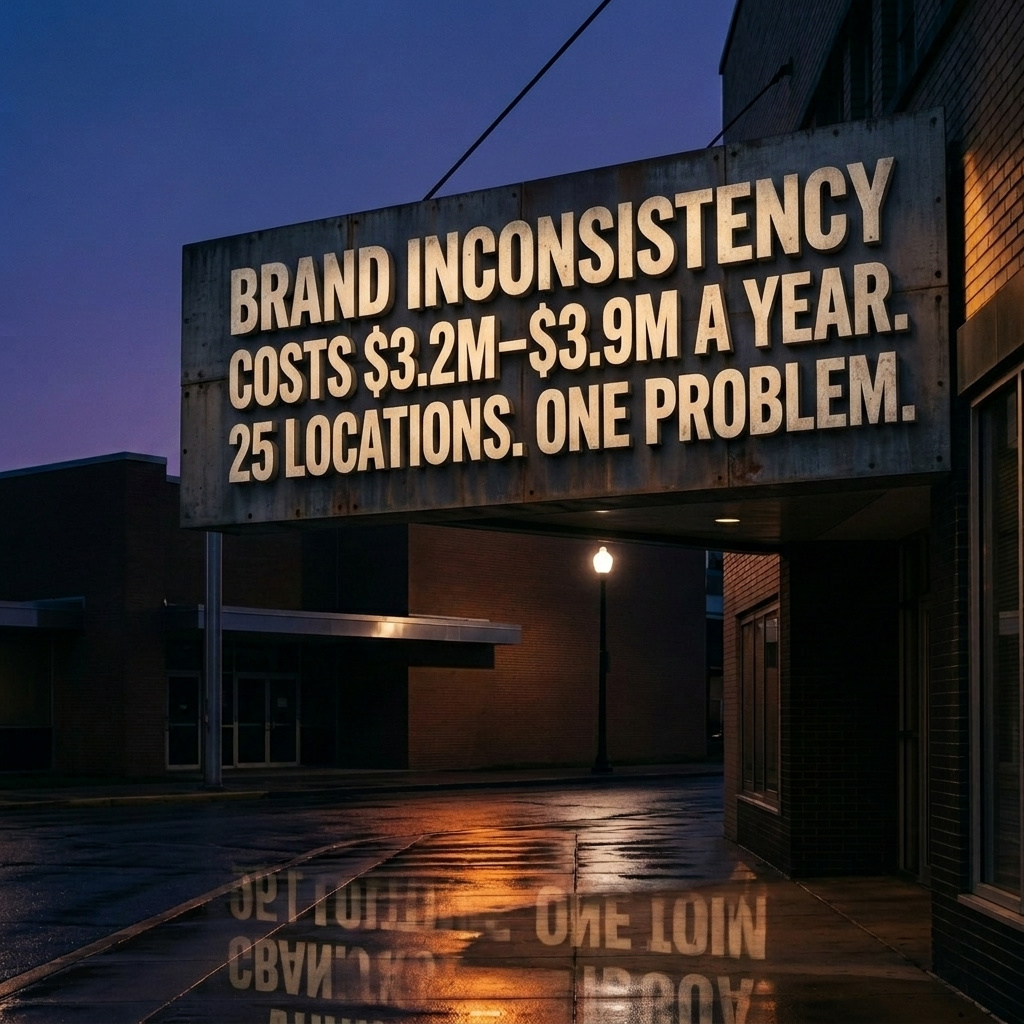
For a 25-location network, brand inconsistency alone costs between $3.2 million and $3.9 million per year. That is not a rounding error. That is a structural liability caused by the absence of operational discipline.
What a Local Marketing System Actually Does
A local marketing system is not about giving each location a different brand. It is about giving each location the ability to execute the same proven playbook while adapting to local market conditions.
The structure looks like this:
Head office controls the strategy. Brand standards, messaging frameworks, approved vendors, measurement protocols. These are non-negotiable.
Locations control the execution. Local sponsorships, community events, neighbourhood partnerships, response to local competition. These require on-the-ground knowledge.
This is governed autonomy. It is not controlled decentralization. It is sophisticated execution.
The most successful franchise marketers use a hub-and-spoke model. The hub sets the standards. The spokes execute within those standards. Everyone sees the same dashboard. Everyone measures the same metrics. Everyone learns from what works.
The Performance Gap Is Measurable
The performance gap between generic corporate pages and dedicated local presence is measurable and significant.
When a franchise location has its own dedicated website, governed by head office standards but optimized for local search, it ranks higher for local queries. It converts better because the content speaks directly to the local market. It builds trust because customers see a business that understands their neighbourhood.
Local marketing provides conversions and customer acquisition. National marketing provides brand awareness. You need both, but if you have to choose where to invest the next dollar, local wins.
The data supports this. Franchise locations with dedicated local marketing systems see higher customer acquisition rates, lower customer acquisition costs, and better retention than locations relying solely on national campaigns.
The Franchisee Engagement Problem
Marketing is the highest priority of any franchise. But most franchisees feel disconnected from it.
When head office controls everything, franchisees become passive recipients of campaigns they did not design and cannot modify. They lose ownership of the one function that drives their revenue.
A hyperlocal marketing system changes this dynamic. It gives franchisees a structured way to provide input, execute locally, and see results. It signals that their opinions and experience matter. It transforms the relationship between head office and franchisees from top-down control to collaborative execution.
Engaged franchisees execute better. They take ownership of local marketing because they see the direct impact on their business. They become advocates for the system because it makes them more successful.
The System Design Problem
Adoption is not a franchisee problem. It is a system design problem.
Systems fail when they add work to a franchisee’s day. If your local marketing system requires franchisees to log into multiple platforms, coordinate with multiple vendors, and manually track results, it will not get used.
The system must reduce friction, not create it.
A properly designed local marketing system automates the repetitive work. It consolidates vendor relationships. It provides a single dashboard for all marketing activities. It makes execution easier than doing nothing.
When the system is designed correctly, franchisees adopt it because it makes their lives easier and their businesses more profitable.
The Balance Between Consistency and Relevance
Franchise digital marketing requires balance between centralized strategy and localized execution.
Brand consistency matters. Customers expect the same experience at every location. But consistency does not mean uniformity.
A franchise location in downtown Toronto has different competitive dynamics than a location in suburban Calgary. The messaging framework can be the same. The specific tactics must adapt to local conditions.
The mistake is thinking one size fits all. It does not. The solution is not to abandon standards. The solution is to build a system that maintains standards while allowing tactical flexibility.
The Real Liability Is Delay
The risk is not buying the system. The real liability is delay.
Every month without a local marketing system is a month of wasted spend, missed opportunities, and competitive disadvantage. Your competitors are building local presence while you debate whether to invest in infrastructure.
The question is not whether each franchise location needs its own local marketing system. The question is whether you can afford to operate without one.
The answer is no.
What This Means for Franchise Leaders
If you run a franchise network, you face a choice.
You can continue operating with centralized campaigns and hope that national brand awareness translates to local customer acquisition. Or you can build a connected local marketing system that gives every location the tools to compete effectively in their market.
The first option is familiar. The second option requires investment in infrastructure, training, and change management.
But the first option is also expensive. It just hides the cost in wasted spend, lost opportunities, and underperforming locations.
The second option is financial discipline disguised as marketing. It is the recognition that consistency compounds faster than creativity in distributed systems. It is the understanding that control is not the enemy of growth. It is the condition for it.
The franchise networks that win in the next 3 to 5 years will be the ones that solve this problem first. They will build systems that balance centralized strategy with localized execution. They will empower franchisees to own local marketing while maintaining brand standards. They will measure what matters and eliminate what does not.
They will recognize that each franchise location does need its own local marketing system. But it needs to be the right system. One that reduces friction, maintains standards, and drives measurable results.
That is the work. Fortunately, it is already done. The system exists and is called BrandCommand – Franchise Marketing OS.