Artificial intelligence is showing up everywhere in franchise marketing.
Your franchisor is investing in it. Marketing vendors are promoting it. Every week there seems to be another AI tool that promises to transform your business.
The question isn’t whether AI is important.
The question is whether it’s helping your location generate more revenue.
Many franchise owners are looking at dashboards full of activity without knowing whether any of it is creating more customers, more sales, or more profit.
That’s the wrong way to evaluate AI.
Higher Visibility Wins
Over the years, I’ve developed a simple philosophy:
**Higher visibility wins.**
If your business isn’t visible when people are searching for what you offer, the best AI in the world won’t create revenue.
Local visibility means your business consistently appears where potential customers are looking, including:
*AI-generated search summaries
*The Google Local Pack
*Organic search results
*Online business directories
*Google Business Profile
*Social media platforms
Your business information also has to be consistent everywhere. Your business name, address, phone number, website, and ordering link all need to match across every platform.
When those fundamentals are in place, AI has something valuable to amplify.
The Metrics That Actually Matter
Many businesses get distracted by AI metrics that look impressive but have little connection to revenue.
Instead, ask whether AI is helping improve these business outcomes:
* Higher local search visibility
* More qualified website traffic
* More inquiries, bookings, or orders
* More revenue for each location
* More positive customer reviews
Everything else is secondary.
If your AI strategy isn’t improving these outcomes, it deserves a closer look.
AI Should Create Momentum Across Your Entire Marketing System
One mistake I see businesses make is treating AI like another software purchase.
They add an AI chatbot.
Then an AI writing tool.
Then an AI image generator.
Then an AI scheduling assistant.
Each application works independently.
The result is a collection of tools instead of a coordinated marketing system.
Local marketing works differently.
Every part of the customer journey influences the next. Visibility creates traffic. Traffic creates conversations. Conversations create customers. Great customer experiences generate reviews. Reviews improve rankings. Better rankings create even more visibility.
AI should strengthen every stage of that cycle instead of solving one isolated task.
A Real Example
One of our mortgage broker clients had almost no online visibility when we started working together.
They needed much more than another AI application.
We built an integrated marketing system that included:
* A conversion-focused website
* Proper landing pages
* Local SEO
* Reputation management
* Consistent content publishing
* Google Search advertising
* Ongoing optimization across every channel
The results after about 18 months speak for themselves.
Today they receive hundreds of new website visitors every week.
They generate approximately 17 qualified leads each month.
Those leads represent roughly $60,000 in monthly lead value.
They started with zero Google reviews.
Today they have more than 100 five-star reviews.
For every marketing dollar they invest, they generate approximately $15.08 in gross lead value, producing a marketing return on investment of about 1,408%.
Those results didn’t come from one AI feature.
They came from building visibility first and allowing AI to improve the performance of the entire marketing system.
What Franchise Owners Should Be Asking
If your franchisor tells you they’re investing heavily in AI, ask questions that connect technology to local business performance.
For example:
* Will this improve my local visibility?
* Will more qualified customers find my location?
* Will it increase leads or appointments?
* Will it improve my online reputation?
* How will success be measured at my location?
Those answers matter far more than a list of AI capabilities.
Stop Measuring AI. Start Measuring Business Growth.
Technology should always support business objectives.
The purpose of AI isn’t to give head office another dashboard full of charts.
The purpose is to help every franchise location become easier to find, easier to choose, and easier to do business with.
That’s how local revenue grows.
As I often tell clients:
Don’t judge AI by individual applications, apps, or software. Judge it by a complete system that works together and provides an agentic AI workforce capable of managing local marketing efficiently across every location.
When AI is connected to a complete local marketing system, the numbers that matter begin to change.
More visibility.
More qualified traffic.
More leads.
More five-star reviews.
More revenue.
Those are the metrics worth tracking.
How do I know if AI is improving my local business?
Look beyond AI dashboards. Measure whether AI increases your local visibility, qualified website traffic, leads, sales, customer reviews, and overall revenue.
What metrics should franchise owners use to measure AI?
The most valuable metrics include local search rankings, Google Business Profile performance, qualified leads, booked appointments, revenue per location, customer reviews, and marketing ROI.
Can AI improve local SEO?
Yes. When AI is part of a complete local marketing system, it can support content creation, reputation management, customer engagement, and local optimization. Results come from the entire system working together rather than a single AI tool.
Is one AI tool enough for franchise marketing?
Usually not. Most franchise locations benefit more from an integrated system where AI supports visibility, lead generation, customer communication, reputation management, and reporting across every stage of the customer journey.
Wondering whether your franchise locations are getting real value from AI?
A lot of business owners are asking some version of this right now.
And the honest answer is: yes, but not without you.
That distinction matters more than you might think. Because when most people ask this question, they are not asking about software. They are asking something much more practical: Can I trust this thing to do a good job, or am I about to light money on fire?
Fair question.
The Part AI Is Actually Great At
Google Ads used to feel like a second career. Keywords, bidding strategies, ad copy, landing pages, negative keywords, quality scores, conversion tracking. The list goes on. Most business owners don’t want to become Google Ads technicians. They want customers.
That’s where AI earns its keep. An AI-powered system like AdCommand can handle the heavy workload that used to make Google Ads so overwhelming:
1
Setting up and structuring your campaigns
2
Creating and testing ad variations
3
Managing bids and reducing wasted spend
4
Removing underperforming keywords
5
Monitoring performance and optimizing over time
That’s a meaningful lift for any business owner who just wants the ads to work.
AI can run the machine. It still needs the right destination.
You can hand a great driver the keys to a Formula 1 car. Without a track to race on, they’re just burning fuel.
What AI Cannot Do for You
AI cannot fix a weak offer. It cannot guess who your best customer is. It cannot save a bad landing page. And it definitely cannot create strategy from thin air.
Before you hand the campaign over to automation, you need five things in place.
1
Know your ideal customerThis goes deeper than age and postal code. You need to understand what problem they’re trying to solve, what they’re actually typing into Google, and what would make them trust you enough to click. The clearer your picture of that person, the better AI can find them.
2
Have a clear offerA Google Ad is an invitation, not an announcement. What are you asking someone to do, and why should they care right now? A mortgage broker might lead with “Renewing soon? Compare your options before signing with your bank.” A restaurant might promote the Tuesday lunch special. A dental clinic might push “Book your hygiene appointment this week.” The offer gives the ad a reason to exist.
3
Do your keyword research firstAI can optimize keywords once the campaign is running, but you need a solid foundation to start from. Know what your best customers are actually searching for, not what you think they might be searching for. That difference is usually where campaigns quietly fall apart.
4
Send people to the right pageThis is where more campaigns fail than anywhere else. An ad about mortgage renewals that sends people to a generic homepage creates confusion. Confused people leave. Your landing page needs to match the ad: same offer, same message, same promise. Don’t make people hunt for what they clicked to find.
5
Know what result you actually wantClicks are a step, not a destination. Do you want more calls? More booked appointments? More table reservations? More quote requests? Your campaign should be judged by what actually grows the business, not by how many people saw the ad.
What Happens When You Get All Five Right
When the strategy is solid, AI can do something genuinely impressive.
For a mortgage broker campaign promoting renewals, AdCommand drove:
$1.26
cost per click on a competitive mortgage campaign
7.91%
click-through rate in a category where 2–3% is typical
In the mortgage space, those are strong numbers. Mortgage ads are competitive. Brokers are bidding against banks, national brands, and local competitors all at once. Clicks in that category are rarely cheap. When an AI-driven system reduces wasted spend and focuses budget on what’s working, the economics of the campaign improve significantly.
The Real Goal
The goal isn’t to “run ads.” It’s to attract the right people at a cost that makes business sense.
What to Expect in the First Few Weeks
One of the most common mistakes business owners make after launching an AI-managed campaign is judging it too early.
Give the system room to work. It needs about two to three weeks to collect data, test ad variations, analyze clicks, and start making smarter decisions. If you panic after two days and start pulling at the controls, you interrupt the learning process.
“Let it learn” doesn’t mean “ignore it forever.” You should still be watching the things that matter:
Which ads are pulling? Which ones aren’t?
What’s the cost per click trending toward?
Are impressions growing over time?
Most importantly: are calls, appointments, bookings, or inquiries increasing?
With AdCommand, you can see what’s happening without drowning in a reporting dashboard you didn’t want to build. AI does the technical heavy lifting. You keep an eye on the business outcome.
So, Can AI Really Run Your Google Ads?
Yes.
It can handle setup, ad creation, bidding, optimization, keyword management, and performance improvement over time. It makes Google Ads faster, more accessible, and significantly less intimidating for business owners who have better things to do than become media buyers.
But the best results still come from combining automation with strategy.
The businesses that will win with AI-managed ads are not the ones who simply “turn it on.” They’re the ones who give it the right strategy to execute: the right customer, the right offer, the right keywords, the right landing page, and a clear definition of what success looks like.
The Bottom Line
AI can run the machine. You still need to tell it where to go.
About AdCommand
AdCommand is BrandCommand’s AI-powered Google Ads management system, built to help Canadian franchise networks and local businesses run smarter campaigns without needing a team of specialists to manage them. Learn more at brandcommand.ca
BRANDCOMMAND™ · One system. Every location. Franchise marketing, finally under command. · brandcommand.ca
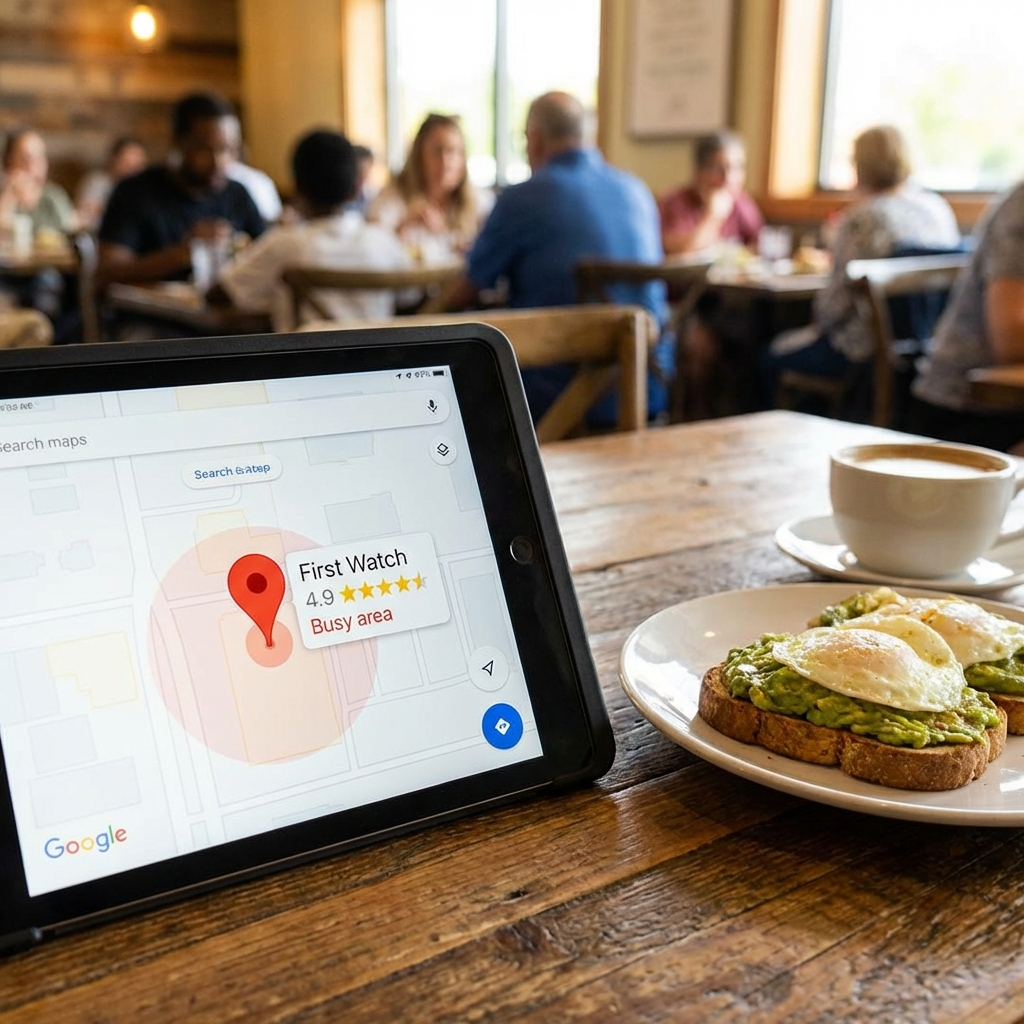
First Watch reported Q4 2025 earnings that beat analyst expectations with GAAP EPS of $0.24. Revenue hit $316 million. Operating margin improved to 2.9%.
But here’s what matters most: same-store sales rose 3.1% year-over-year.
That growth happened while same-restaurant traffic decreased by 1.9%. The company opened 64 new restaurants in 2025 and acquired 19 franchise locations. They now operate 633 restaurants and target a potential footprint of more than 2,200 locations.
The real story sits in their digital marketing test regions. Those areas experienced a several hundred basis point increase in traffic. Management plans a full system rollout in fiscal 2026.
I’ve watched this pattern before. The winners in multi-location restaurant growth understand one principle: local SEO determines who owns the category in each market.
The Local Search Behavior That Drives Restaurant Revenue
Look at the numbers. 98% of customers search online for nearby companies. That’s up from 90% in 2019.
More telling: 76% of “near me” mobile searches lead to a store visit within 24 hours. For restaurants, local search visibility converts to foot traffic the same day.
First Watch’s digital marketing test regions proved this. When you dominate local search results, traffic increases by hundreds of basis points. When you don’t, you’re invisible to the 62% of consumers who use local search results when looking for restaurants.
The restaurant industry will surpass $1.1 trillion in traditional sales in 2026. That’s a 4.1% year-over-year increase. But the brands capturing that growth are the ones who show up first in local search.
Google Business Profile: The Modern Full-Page Ad
I tell clients that an optimized Google Business Profile is the equivalent of a full-page Yellow Pages ad in 1995.
It’s not a comparison. It’s the same strategic position.
Based on a 2025 Malou study of 300+ locations, restaurants optimizing their Google Business Profile get 2.3x more reviews than others and at least 15% more interactions after six months.
Restaurants that actively manage their profile get 70% more engagement on Google. That engagement translates to calls, direction requests, and online orders.
First Watch operates 633 locations. Each location competes in its own local market. Each market has its own search behavior, competition, and customer base. You can’t win 633 local markets with a single corporate website and hope.
You win by optimizing each Google Business Profile. You win by managing reviews at the location level. You win by ensuring every profile has accurate hours, complete service details, and regular updates.
The Multi-Location Challenge First Watch Solved
Managing one Google Business Profile takes discipline. Managing 633 takes a system.
Multi-location restaurant brands face a specific problem. Corporate wants brand consistency. Local managers need flexibility to respond to their market. Customers expect accurate, current information for their specific location.
Most brands fail at this. They either centralize everything and lose local relevance, or they decentralize and lose brand consistency.
First Watch’s digital marketing test regions worked because they solved this problem. They created a system that maintains brand standards while optimizing for local search in each market.
The result: several hundred basis points of traffic increase in test regions. That’s not incremental improvement. That’s category dominance.
Reviews Drive Decisions and Rankings
Here’s what most restaurant operators miss: reviews do double duty.
First, they influence customer decisions. 47% of diners are more likely to visit a restaurant if they see the business responds to reviews. And 88% of potential diners trust online reviews as much or more than word-of-mouth recommendations.
Second, they impact local search rankings. Google’s algorithm factors review quantity, recency, and response rate into local pack rankings.
Research from Harvard Business School shows that a one-star increase in a restaurant’s Yelp rating correlates with a 5-9% increase in revenue.
First Watch’s expansion to 633 locations means they need a review management system that works at scale. You can’t manually monitor and respond to reviews across hundreds of locations. You need automation with human oversight.
The Traffic to Revenue Conversion
Local SEO drives traffic. But traffic only matters if it converts.
First Watch’s same-store sales increased 3.1% while traffic decreased 1.9%. That tells me they’re converting higher-quality customers. Local SEO brings in customers who already decided to visit. They searched for breakfast restaurants near them. They saw First Watch in the local pack. They clicked for directions.
That’s a qualified lead. They’re not browsing. They’re ready to eat.
Compare that to traditional advertising. You pay to interrupt someone’s day and hope they remember your brand when they get hungry. Local SEO captures customers at the moment of intent.
The conversion rate reflects this. 28% of searches for something nearby lead to a purchase. Nearly one in three local retail searches convert to sales.
The 2026 Rollout and What It Means
First Watch plans a full system rollout of their digital marketing strategy in fiscal 2026. They tested it in select regions. It worked. Now they’re scaling it across all 633 locations.
This is how category leaders operate. They test. They measure. They scale what works.
The several hundred basis point traffic increase in test regions will compound across the entire system. That’s not just growth. That’s market share capture from competitors who are still guessing about their marketing.
Over 65% of restaurant searches start on Google Maps or mobile “near me” queries. First Watch is positioning every location to win those searches.
What This Means for Multi-Location Service Brands
First Watch’s strategy applies beyond restaurants. Any multi-location service business faces the same challenge: how do you dominate local search in every market you operate?
The answer is systematic local SEO. You need a centralized system that optimizes each location’s Google Business Profile. You need automated review management that maintains response rates. You need consistent posting across locations while allowing for local customization.
Most importantly, you need measurement. First Watch tested their digital marketing strategy in specific regions before rolling it out system-wide. They measured traffic increases. They tracked conversion rates. They proved ROI before scaling.
That’s strategic marketing. You don’t guess. You test, measure, and scale what works.
The Local SEO Advantage Compounds
Here’s what makes local SEO powerful for multi-location brands: the advantage compounds.
When you rank first in local search, you get more clicks. More clicks lead to more reviews. More reviews improve your rankings. Better rankings bring more clicks.
It’s a reinforcing loop. The brands that establish local search dominance early create a moat that competitors struggle to cross.
First Watch’s 64 new restaurant openings in 2025 benefit from this. Each new location can leverage the brand’s review management system, Google Business Profile optimization, and local SEO strategy from day one.
They’re not starting from zero. They’re starting with a proven system that delivers several hundred basis points of traffic increase.
The Bottom Line
First Watch’s Q4 2025 results show what happens when a multi-location brand gets local SEO right. Same-store sales increased 3.1%. Operating margin improved to 2.9%. Digital marketing test regions experienced several hundred basis points of traffic increase.
The 2026 system-wide rollout will amplify these results across all 633 locations.
This is the pattern I see with category leaders. They recognize that local SEO is the primary discovery mechanism for customers. They build systems to dominate local search in every market they operate. They measure results and scale what works.
The restaurant industry will generate $1.1 trillion in sales in 2026. The brands capturing that growth are the ones who show up first when customers search for restaurants near them.
Local SEO determines who owns the category. First Watch proved it in their test regions. Now they’re scaling it across their entire system.
That’s how you win in multi-location service businesses. You don’t compete on price or hope. You compete on visibility. You own local search in every market you operate. My BrandCommand Franchise Marketing System can do this for you. Book a demo and see for yourself: https://bookmenow.info/book/bill-jackman/brandcommand-demo
Every service business owner faces the same question right now: Will AI replace the human element in marketing?
The answer surprises most people.
AI automation makes human connection more valuable, not less. I’ve promoted relational marketing for 25 years, and I’ve never seen a moment where authentic relationships mattered more than they do today.
Virtually all successful advertisers now rely on automation. It’s table stakes.
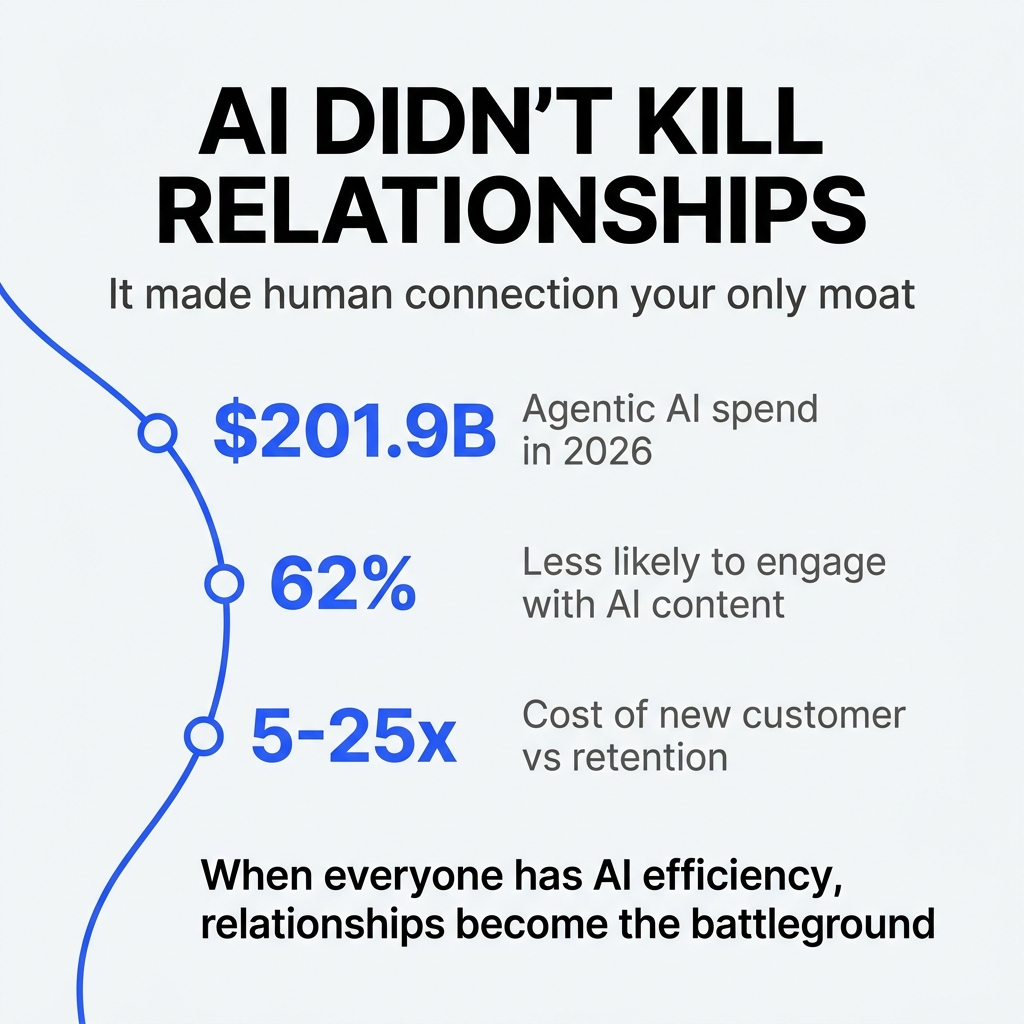
When everyone has access to the same AI tools, efficiency itself becomes commoditized. You can’t win on automation alone anymore because your competitors have the same capabilities.
The battleground shifts.
What AI Can’t Replicate
The data tells a clear story about consumer trust.
About 62% of consumers are less likely to engage with content when they know AI generated it. Half of consumers can correctly identify AI-generated copy. When they suspect content came from an algorithm, 52% become less engaged.
Trust isn’t a soft brand value anymore. It’s a measurable performance constraint.
Your service business has something AI can never replicate: face-to-face relationships built during actual service delivery. Every interaction with a customer becomes a competitive moat that purely digital competitors can’t cross.
The IBC Framework Changes Everything
I work with service businesses to identify their Ideal Brand Clients (IBCs). These customers make your staff happier when they walk through the door.
IBCs have a low PITA factor. That’s pain-in-the-ass factor, measured on a 1-5 scale.
They spend more. They visit more frequently. They value your staff’s contribution. When something goes wrong, they’re forgiving because the relationship matters more than a single transaction.
Then you have Less Than Ideals (LTIs). They consume 80% of your staff’s time but generate only 20% of your revenue. They chase your lowest price. They have zero loyalty. When problems arise, they broadcast complaints everywhere.
Here’s the strategic move: Use AI to filter out LTIs before they become your problem. Let them drain your competitors’ resources instead.
When you focus staff energy on IBCs, turnover drops. Service quality improves. Your team becomes your competitive advantage.
How Relationship Intelligence Trains Better AI
Businesses that built strong relationships before AI arrived now have a massive advantage.
They know their IBCs deeply. They understand the detailed history of these customers in their local market. They know how IBCs feel about the brand and services.
This relationship knowledge makes AI outputs more authentic. More human.
A business guessing at their audience produces generic AI content. A business with relationship intelligence produces AI content that resonates because it’s grounded in real customer understanding.
The difference shows up in conversion rates.
Local Presence as Strategic Moat
Acquiring a new customer costs 5 to 25 times more than retaining an existing one. Customer acquisition costs rose approximately 60-75% for both B2C and B2B businesses from 2014 to 2019.
When multiple businesses in a market use AI to hunt the same IBCs, proof of genuine relationships wins.
These elements create barriers to entry that AI alone can’t overcome.
For multi-location businesses, this becomes systematic. Each location builds hyper-local proof through local website presence, citations, photos, and stories. You’re not creating corporate-manufactured community involvement. You’re spotlighting local people working in your business, sharing what’s happening in the neighborhood, celebrating the people and events in close proximity to each location.
I call this Connected Hyper Local Marketing. It’s the winning strategy for franchises and multi-location operators.
The Brand Identity Shift
My dentist of 35 years recently retired. I only saw him once a year, but I knew he looked after my dental health to the best of his abilities.
That relationship made me feel like someone who looks after his dental health to the best of his abilities.
The brand became part of my identity.
This works for any service business. Your plumber. Your HVAC company. Your physiotherapist. When customers define themselves through their relationship with your brand, price becomes secondary.
AI handles the acquisition mechanics. Humans build the identity connection.
The Division of Labor That Wins
AI excels at efficiency. It automates customer acquisition, manages reviews, optimizes local SEO, and runs conversion campaigns around the clock.
This efficiency frees your team to focus on what AI can’t do: building trust during face-to-face service delivery, creating genuine community connections, and turning customers into people who identify with your brand.
The businesses winning in 2026 use AI as a filter and amplifier. They filter out LTIs. They amplify their local presence. They systematize relationship building across locations.
They don’t replace human connection. They create more space for it.
What This Means for Your Business
You need to make a choice.
You can chase efficiency alone and compete with everyone else who has the same AI tools. Or you can use AI to free up resources for the relationship building that creates actual competitive advantage.
Define your IBCs. Measure their PITA factor. Use AI to attract more of them and repel LTIs. Build systematic local presence across your locations. Train your AI with relationship intelligence, not guesswork.
The pendulum swung from transactional to relational marketing. AI didn’t cause this shift. It accelerated it.
In a sea of automation, human connection becomes your most valuable asset.
The question isn’t whether AI will replace relationships. The question is whether you’ll use AI to build deeper ones.
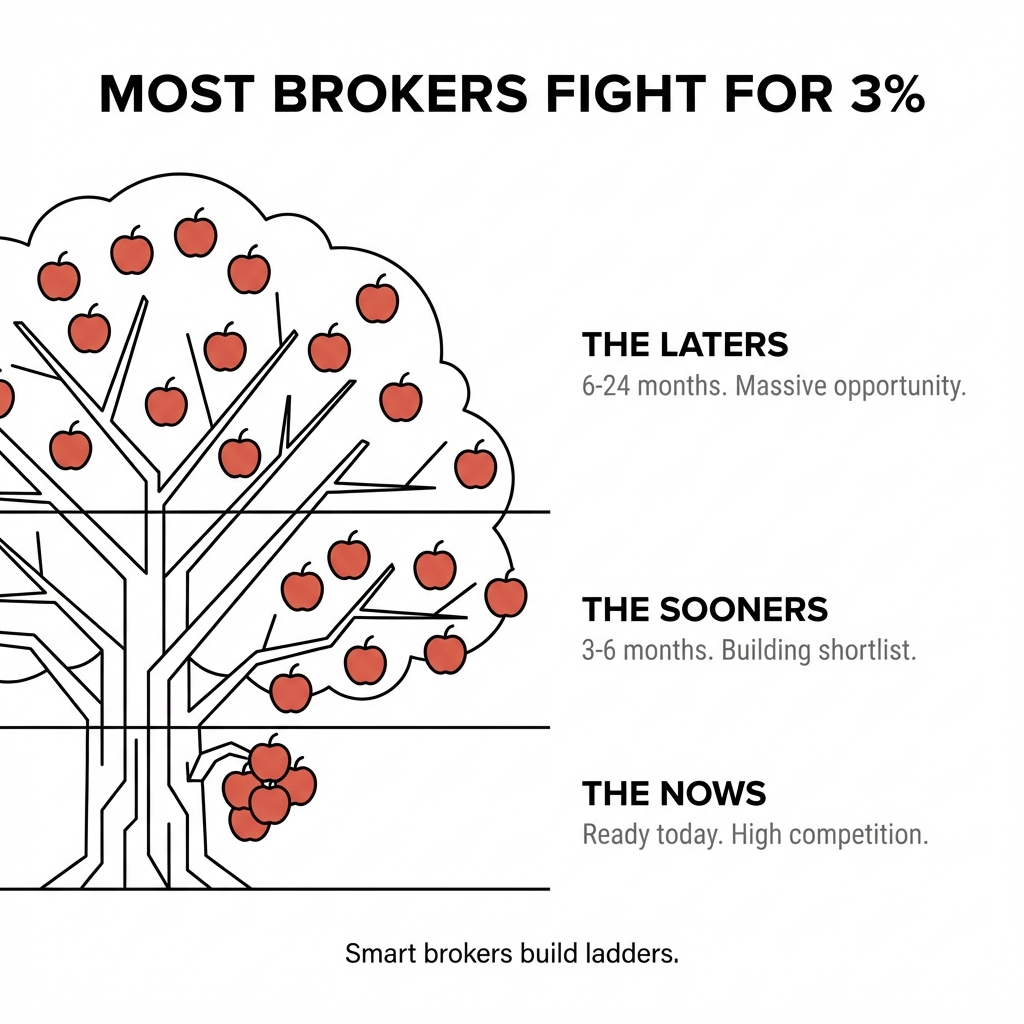
Most mortgage brokers are fighting over the same 3% of homebuyers who are ready to close next week.
Meanwhile, 93% of Gen Z still wants to own homes someday. But they’re not calling mom and dad for broker referrals anymore.
The referral networks that built careers over decades are fragmenting. Families are scattered. Gen Z homebuying patterns show they research independently, judge you by your Google reviews, and make decisions based on social proof rather than family recommendations.
This creates a fundamental problem. Every broker is chasing the same “now” buyers while ignoring the massive pipeline of future clients.
The Apple Tree Problem
Think of your market like an apple tree.
Most brokers are jumping for the low-hanging fruit. The ready-to-buy-today clients on the bottom branches. Everyone sees those apples. Everyone fights for them.
But the real harvest is in the middle and top of the tree. The prospects who won’t buy for 6, 12, or 18 months. The ones doing early research, comparing options, building trust over time.
Smart brokers build ladders. They create systems to reach the entire tree.
The Nows, Sooners, Laters Framework
I break every prospect pipeline into three categories:
The Nows: Ready to buy immediately. Every broker fights over these. High competition, low margins, stressful closes.
The Sooners: Actively researching, comparing options. Timeline is 3-6 months. They’re building their short list.
The Laters: Early awareness stage. They know they want to buy someday but haven’t committed to a timeline. Could be 6-24 months out.
Most brokers only see the Nows. They spend all their marketing budget competing for immediate buyers.
The winning strategy captures all three categories. When your Laters become Sooners, and your Sooners become Nows, you’re already their trusted guide.
Why AI Changes Everything
The search behavior shift is happening faster than most brokers realize.
Traditional search behavior shift data shows search engine volume will drop 25% by 2026. Gen Z prospects are asking AI assistants questions instead of scrolling through broker websites.
This creates opportunity for brokers who adapt early.
AI-driven systems can handle the qualification and nurturing that used to require manual follow-up. AI automation benefits include 30-50% reduction in time spent on routine inquiries.
Your AI webchat captures the 11 PM question: “Can I afford a house with student loans?”
Your AI voice receptionist books qualification calls while you sleep.
Your automated email sequences keep you top-of-mind during the 18-month research process.
The Chickening Out Period
Here’s what most vendors won’t tell you: the first 12-14 weeks are rough.
You’ll feel upside down. You’ll question the investment. You’ll wonder if the old way was better.
I call this the chickening out period. Every broker goes through it.
The difference between success and failure is pushing through those first three months. That’s when the system starts learning, your rankings improve, and the pipeline begins filling with qualified prospects.
You’re not just building a marketing system. You’re building a competitive moat.
The Hockey Stick Reality
AI adoption follows a hockey stick curve. Slow at first, then exponential.
In the next 3-5 years, every serious mortgage broker will be using AI-driven marketing systems. The question is whether you’ll be early or late to the party.
Early adopters capture market share while competitors are still manually qualifying leads and chasing referrals from retired networks.
Late adopters find themselves competing against brokers who have 18-month head starts on pipeline development and client education.
Building Your Ladder
The winning brokers are already building unified AI systems that capture anonymous website visitors and nurture them through the entire buying journey.
They’re optimizing Google Business Profiles to show up in AI search summaries.
They’re creating content that educates Gen Z prospects about avoiding their parents’ financial mistakes.
They’re setting up automated review management and reputation systems.
Most importantly, they’re thinking in quarters instead of weeks. They’re playing the long game while competitors fight over scraps.
The mortgage industry is splitting into two groups: brokers who harvest the whole tree, and brokers who keep jumping for the same low-hanging fruit.
I’ve been watching something happen in local search that most multi-location businesses haven’t noticed yet.
AI Overviews now appear in over 13% of all searches. That number jumped 72% in just one month.
For local business queries, AI Overviews show up 40.2% of the time.
Here’s what that means for you: Your best location can be invisible even when you rank first.
The Old Rules Don’t Apply
Traditional local pack rankings used to follow predictable patterns. Distance mattered. Reviews mattered. Your Google Business Profile optimization mattered.
AI Overviews ignore most of that.
Research shows effectively no correlation between distance and ranking position in AI Overviews. The correlation coefficient is 0.001.
Your clinic three blocks away loses to a competitor across town because AI reads different signals.
Position #1 in traditional search saw click-through rates drop 39% when AI Overviews appear. You’re ranking. You’re just not getting found.
ChatGPT Converts Better Than Google
Here’s where it gets interesting.
Business websites make up 58% of all local search sources in ChatGPT Search. Visitors coming from ChatGPT answers were 6x more likely to sign up compared to those from Google Search.
People trust AI recommendations differently. When ChatGPT suggests your law firm or dental practice, it signals trust before the click happens.
The problem is getting ChatGPT to recommend you in the first place.
Reddit Became Your New SEO Channel
I know this sounds strange, but stay with me.
Reddit accounts for 11.3% of all ChatGPT citations. One or two positive mentions in niche subreddits can move the needle on AI-generated answers.
Reddit’s traffic jumped from 500 million to 3.4 billion monthly visits after its data licensing deal with Google.
Your brand mentions in Reddit threads now feed directly into what AI tools recommend.
This isn’t about gaming the system. It’s about understanding where AI sources its local business intelligence.
The Shift From Ranking to Answer Shaping
Traffic to websites from organic search is declining because of AI-influenced searches.
The search landscape moved from ranking to answer shaping. Users expect direct answers, comparisons, and recommendations without browsing links.
Your website serves more as a data repository for AI consumption than a traditional sales tool.
I’ve seen this with the multi-location businesses I work with. The ones adapting their content strategy for AI consumption are maintaining visibility. The ones optimizing for 2019 SEO tactics are disappearing.
What This Means for Your Business
You need to think about local visibility differently now.
Your Google Business Profile optimization still matters. But it’s no longer enough.
Your website content needs to answer the questions AI tools are trying to solve. Clear service descriptions. Specific location information. Genuine customer stories.
Your brand mentions across platforms feed into AI knowledge bases. Community involvement. Review responses. Industry participation.
The businesses winning in this environment have strong strategic foundations. They know who they serve, what problems they solve, and how they’re different.
AI amplifies clarity. It also amplifies confusion.
The Two-Tier Market Is Here
I predict we’ll see a two-tier market emerge faster than most people expect.
Businesses with strategic positioning and AI-optimized presence will dominate local search results. Everyone else will fight over scraps.
The gap between these two groups will widen quickly because AI recommendations create compounding advantages. Get recommended once, you get more reviews. More reviews lead to more recommendations.
The time to adapt is now, not when your lead volume drops 40%.
This isn’t about chasing the latest marketing trend. It’s about understanding how customers find local businesses in 2025.
The rules changed. Your strategy needs to change with them.