Every service business owner faces the same question right now: Will AI replace the human element in marketing?
The answer surprises most people.
AI automation makes human connection more valuable, not less. I’ve promoted relational marketing for 25 years, and I’ve never seen a moment where authentic relationships mattered more than they do today.
The Efficiency Paradox Nobody Talks About
Here’s what’s happening in 2026.
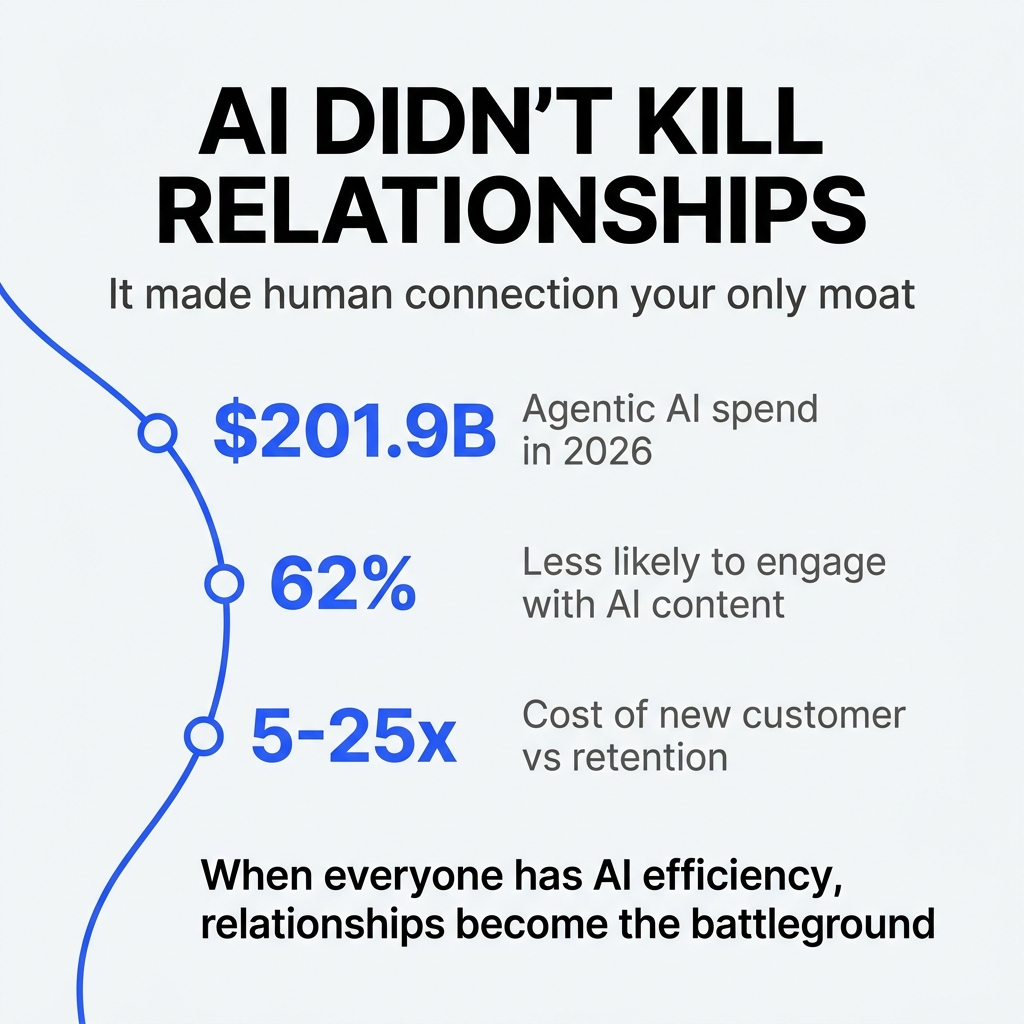
Agentic AI spending reaches $201.9 billion this year. By the end of 2026, 40% of enterprise applications will embed AI agents, up from less than 5% in 2025.
Virtually all successful advertisers now rely on automation. It’s table stakes.
When everyone has access to the same AI tools, efficiency itself becomes commoditized. You can’t win on automation alone anymore because your competitors have the same capabilities.
The battleground shifts.
What AI Can’t Replicate
The data tells a clear story about consumer trust.
About 62% of consumers are less likely to engage with content when they know AI generated it. Half of consumers can correctly identify AI-generated copy. When they suspect content came from an algorithm, 52% become less engaged.
Trust isn’t a soft brand value anymore. It’s a measurable performance constraint.
Your service business has something AI can never replicate: face-to-face relationships built during actual service delivery. Every interaction with a customer becomes a competitive moat that purely digital competitors can’t cross.
The IBC Framework Changes Everything
I work with service businesses to identify their Ideal Brand Clients (IBCs). These customers make your staff happier when they walk through the door.
IBCs have a low PITA factor. That’s pain-in-the-ass factor, measured on a 1-5 scale.
They spend more. They visit more frequently. They value your staff’s contribution. When something goes wrong, they’re forgiving because the relationship matters more than a single transaction.
Then you have Less Than Ideals (LTIs). They consume 80% of your staff’s time but generate only 20% of your revenue. They chase your lowest price. They have zero loyalty. When problems arise, they broadcast complaints everywhere.
Here’s the strategic move: Use AI to filter out LTIs before they become your problem. Let them drain your competitors’ resources instead.
When you focus staff energy on IBCs, turnover drops. Service quality improves. Your team becomes your competitive advantage.
How Relationship Intelligence Trains Better AI
Businesses that built strong relationships before AI arrived now have a massive advantage.
They know their IBCs deeply. They understand the detailed history of these customers in their local market. They know how IBCs feel about the brand and services.
This relationship knowledge makes AI outputs more authentic. More human.
A business guessing at their audience produces generic AI content. A business with relationship intelligence produces AI content that resonates because it’s grounded in real customer understanding.
The difference shows up in conversion rates.
Local Presence as Strategic Moat
Acquiring a new customer costs 5 to 25 times more than retaining an existing one. Customer acquisition costs rose approximately 60-75% for both B2C and B2B businesses from 2014 to 2019.
When multiple businesses in a market use AI to hunt the same IBCs, proof of genuine relationships wins.
Reputation matters. Reviews matter. Awards matter. Community recognition matters. Sponsorships matter.
These elements create barriers to entry that AI alone can’t overcome.
For multi-location businesses, this becomes systematic. Each location builds hyper-local proof through local website presence, citations, photos, and stories. You’re not creating corporate-manufactured community involvement. You’re spotlighting local people working in your business, sharing what’s happening in the neighborhood, celebrating the people and events in close proximity to each location.
I call this Connected Hyper Local Marketing. It’s the winning strategy for franchises and multi-location operators.
The Brand Identity Shift
My dentist of 35 years recently retired. I only saw him once a year, but I knew he looked after my dental health to the best of his abilities.
That relationship made me feel like someone who looks after his dental health to the best of his abilities.
The brand became part of my identity.
This works for any service business. Your plumber. Your HVAC company. Your physiotherapist. When customers define themselves through their relationship with your brand, price becomes secondary.
AI handles the acquisition mechanics. Humans build the identity connection.
The Division of Labor That Wins
AI excels at efficiency. It automates customer acquisition, manages reviews, optimizes local SEO, and runs conversion campaigns around the clock.
This efficiency frees your team to focus on what AI can’t do: building trust during face-to-face service delivery, creating genuine community connections, and turning customers into people who identify with your brand.
The businesses winning in 2026 use AI as a filter and amplifier. They filter out LTIs. They amplify their local presence. They systematize relationship building across locations.
They don’t replace human connection. They create more space for it.
What This Means for Your Business
You need to make a choice.
You can chase efficiency alone and compete with everyone else who has the same AI tools. Or you can use AI to free up resources for the relationship building that creates actual competitive advantage.
Define your IBCs. Measure their PITA factor. Use AI to attract more of them and repel LTIs. Build systematic local presence across your locations. Train your AI with relationship intelligence, not guesswork.
The pendulum swung from transactional to relational marketing. AI didn’t cause this shift. It accelerated it.
In a sea of automation, human connection becomes your most valuable asset.
The question isn’t whether AI will replace relationships. The question is whether you’ll use AI to build deeper ones.