BrandCommand · Franchise Marketing
The marketing budget question almost always arrives at the wrong time.
It comes up after the lease is signed. After the franchise agreement is finalized. After the buildout is underway. By then, payroll, rent, food costs, insurance, utilities, royalty fees, and franchise fund contributions are already eating into cash flow.
Then someone asks: “How much should I spend on marketing?”
Here is the honest answer: a QSR franchisee should not copy a generic industry percentage. The right number comes from expected revenue, real margins, location economics, and the local visibility your market actually requires to win.
The Formula
Start here:
Local Marketing Budget Formula
Expected gross revenue × 10–12% × average markup − location costs − franchise marketing fund contribution = realistic local marketing budget
For a QSR location expecting $1,000,000 in annual revenue, the starting range is $100,000 to $120,000 per year before adjustments. That is not what you should spend locally. It is the ceiling you work down from.
Adjust for margin. If your average markup is strong, you have room to invest. If your cost of goods is high or pricing is tight in your market, the number needs to come down.
Then subtract your true location costs: rent, CAM, utilities, insurance, and the full cost of where your restaurant sits. A QSR in a high-traffic mall pays more per square foot but benefits from built-in foot traffic. A standalone location off the beaten path has lower rent but must work harder to become a destination.
The Rent Trap
Cheap rent becomes expensive if nobody knows you exist. Low occupancy costs are not a marketing subsidy. They are a liability in disguise.
National Marketing Is Not Enough
Many franchisees assume their required contribution to the national fund will generate enough local traffic. This is a dangerous assumption.
National marketing builds the brand. It creates awareness and supports broad recognition. But it does not always create enough frequency in every local market to drive the traffic a single location needs.
The lesson here comes from experience as a franchisee. Paying into a national advertising fund while television campaigns were concentrated in larger markets meant the local market was not getting enough reach or frequency. So we supplemented: radio, billboards, online marketing, email. We built our own local traffic because the national campaign alone was not enough.
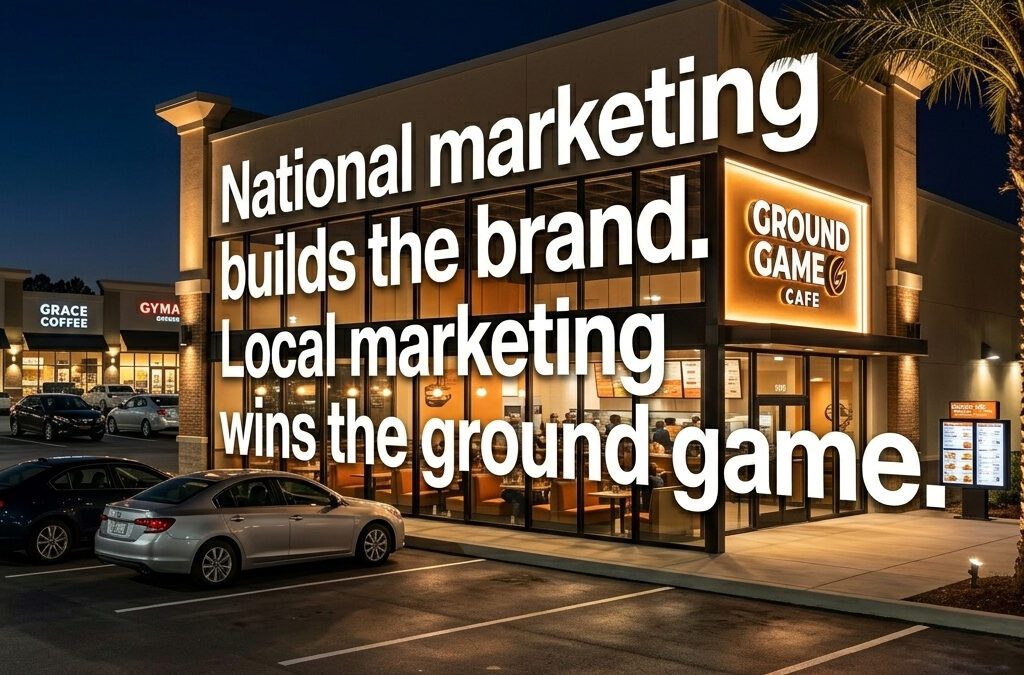
National marketing wins the brand. Local marketing wins the ground game. In QSR, the ground game is everything.
The Real Goal: Get Customers Back Four Times
The first visit matters. The second, third, and fourth visits matter more.
A customer who tries your restaurant once is still transactional. They bought a meal. If you bring them back repeatedly, the relationship changes. They become familiar with your food, your staff, and your experience. Your location moves from a transaction to a routine.
This is where the economics of QSR actually work. Local marketing should be built around repeat visits, not just first-time traffic. Bounce-back offers, loyalty campaigns, email and SMS programs, review requests, and local community connection all serve one goal: making your restaurant part of someone’s week.
What to Fund Before You Run Campaigns
Before spending money on paid campaigns, a QSR franchisee needs to fund the local visibility foundation. These are operating requirements, not optional extras.
-
1
Google Business ProfileYour most important local marketing asset. Keep it complete, accurate, active, and updated. Hours, menu links, photos, and responses all affect how often you show up.
-
2
Listings and citation managementYour name, address, phone number, and hours must be consistent across every directory, map, and platform. Inconsistency hurts visibility and erodes trust.
-
3
Review generation and responseReviews are local ranking signals, trust signals, and customer insight tools. You need a system for requesting, responding, monitoring, and learning from them.
-
4
Local SEO and answer engine visibilityCustomers search using AI summaries, voice, and maps. Your location needs content and local signals to appear when people ask where to eat, who delivers, and which location is closest.
-
5
Email and SMS marketingThe most direct line to your existing customers. Essential for offers, events, loyalty pushes, new menu items, and bounce-back campaigns.
-
6
Bounce-back offers and loyalty campaignsThe first visit triggers the second. The second triggers the third. The third triggers the fourth. This chain does not happen by accident. Build it deliberately.
-
7
Social media, done locally and consistentlyNot random posting. A local social presence that supports visibility, shows personality, highlights offers, and connects your restaurant to the community it serves.
-
8
Focused community sponsorshipsDo not spread sponsorship dollars too thin. Pick causes, teams, or events that matter to your staff and customers, then go deeper. Focused sponsorship creates more visibility and more meaning.
The Danger of Setting the Budget Too Low
Setting a marketing budget too low is as damaging as setting it too high.
Too high and you burn through cash without the results you need. Too low and you never create the frequency, visibility, or momentum required for marketing to work. A weak, inconsistent budget produces weak, inconsistent results.
A new QSR location should begin marketing before the doors open. The pre-opening period is where local anticipation is created. If demand is built before launch, the grand opening has a genuine chance to create momentum rather than just foot traffic that disappears. The first 90 days are critical, but the 30 days before opening matter just as much.
Marketing Is Not a Leftover Cost
This is the point most franchisees need to hear: marketing is not something you fund with whatever money remains after everything else. It is one of the highest-priority costs in the business.
Yes, you are in the food business. Yes, you are in the service business. But as a franchisee, you are also in the marketing business. Your job is to make your location known, chosen, visited, reviewed, remembered, and revisited.
Local visibility is not optional. Repeat visits are not optional. Review growth is not optional. Customer communication is not optional. These are operating requirements.
The Best Customers Are Built Through Repetition
The ideal QSR customer is not someone who buys once. The ideal customer comes back often. They spend more. They bring others. They leave positive reviews. They speak highly of your restaurant. And they forgive the occasional mistake because they already have a relationship with your brand.
This kind of customer does not happen by accident. You build that relationship through visibility, consistency, experience, follow-up, and trust. Reviews matter because they create commitment. When someone publicly says they had a good experience, they are more likely to return.
A review is not just a reputation asset. It is a relationship marker.
Final Answer: How Much Should a QSR Franchisee Budget for Marketing?
Start with 10% to 12% of expected gross revenue. Adjust for your margin and location economics. Subtract your franchise fund contribution. Invest what remains in local visibility with discipline and consistency.
The brand helps create awareness. The franchisee still has to win the local ground war.
The Simplest Rule in QSR Marketing
Highest visibility wins.
The franchisee who treats marketing as a core operating cost, not an afterthought, gives their location the best chance to grow.