I keep hearing the same advice from experienced marketing people: “Build one corporate website with location pages. Simpler. Cheaper. Easier to manage.”
On paper, this sounds reasonable.
Here’s what I’ve learned after years of watching service-based franchises struggle with local visibility: the advice costs you customers.
The truth is more uncomfortable than most franchisors want to admit. A centralized corporate website with location pages fails both the brand and the market. Looks organized in a boardroom presentation, underperforms where things matter… local search results, AI recommendations, and the minds of customers searching for help right now.
The Problem With Location Pages Nobody Talks About
Location pages feel efficient. One site. One domain. One content management system. Clean org chart. Tidy budget line. I get the appeal.
Search engines and AI systems don’t reward organizational tidiness.
They reward entity-level clarity.
When you bury a location under a corporate URL structure, you’re sending a weak signal. Telling Google, ChatGPT, and every other discovery platform this location is subordinate. A branch office. An afterthought.
And that’s exactly how those systems treat it.
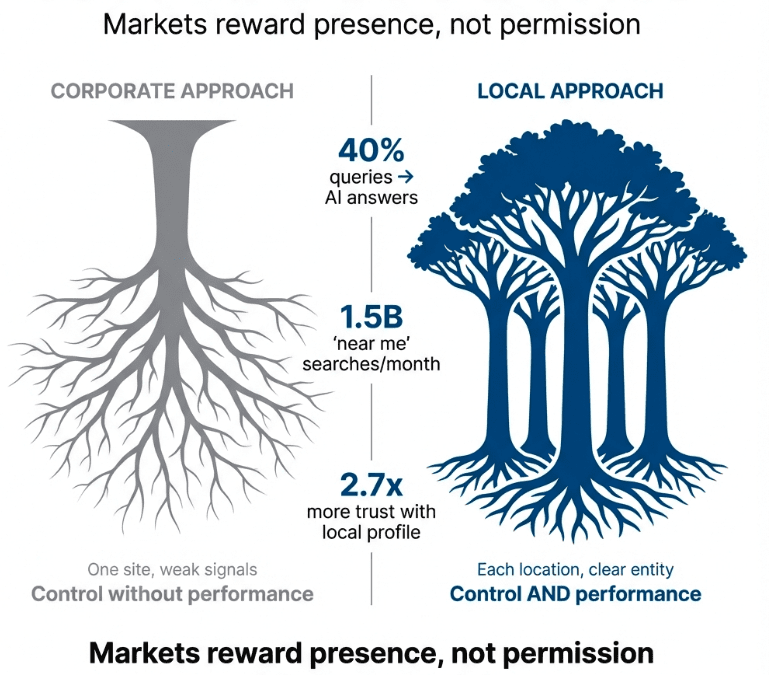
Here’s what’s happening: 40.16% of local business queries now trigger Google’s AI Overviews. When someone searches for a service near them, they see an AI-generated answer before traditional search results. AI systems think in terms of distinct entities. Your business, its owner, services, location, and products are all separate entities needing clear mapping.
Location page on a corporate site? Fuzzy signal.
Dedicated website for each location? Clear entity with local authority, local intent, and local relevance.
Markets reward presence. Not permission.
What AI Search Means for Your Local Visibility
Most franchise marketers haven’t realized this yet: 60% to 70% of local results on ChatGPT come straight from Foursquare’s city guide listings.
A customer might see you at #1 in Google Maps, then ask ChatGPT for advice and get a completely different recommendation. Or Google AI Overviews might summarize local options without including your business, even though you rank well in traditional search.
This changes the game. You’re no longer competing for Google rankings. You’re competing to be the AI’s recommendation.
AI systems don’t think in sitemap hierarchies. They think in distinct businesses with clear signals.
A standalone site has:
- Its own authority
- Its own content graph
- Its own review and citation ecosystem
This matters more as AI replaces traditional search behavior.
The “Near Me” Reality Your Corporate Site Can’t Solve
1.5 billion searches each month include “near me.”
46% of people say they often include “near me” in their search queries. Even more compelling: 88% of consumers who conduct a local search on their smartphone visit or call a store within a day.
Not browsing behavior. Buying behavior.
Those searches reveal something: customers want a local business, not a corporate entity with local branches.
When your location exists only as a page on a corporate site, you’re asking customers to mentally translate. “Is this a local business? Or am I dealing with a call center? Will I get someone who knows my area?”
A dedicated site answers those questions immediately. Signals: real local business. Local authority. Local intent.
The critical distinction: a location page is similar to a service area page. The main difference is the business has a physical location in the market. If your business serves multiple areas, you need dedicated landing pages for each one with 100% unique content. As long as your content is unique and you genuinely serve the area, these location pages help you rank in local organic results and drive high-converting traffic.
Many law firms and multi-location service businesses have learned this: you see higher engagement and conversion rates when you add targeted location pages to your website. The performance gap between generic corporate pages and dedicated local presence is measurable and significant.
The Google Business Profile Multiplier Effect
Customers are 2.7 times more likely to consider a business reputable if they have a complete business profile on Google Search and Maps.
They’re 70% more likely to visit and 50% more likely to consider purchasing.
What most franchisors miss: you need a separate, fully optimized Google Business Profile for each location. Your website should have a unique, dedicated location page for each branch with specific content, NAP (name, address, phone), and a map.
Do not lump all your locations onto a single contact page.
This destroys the multiplier effect. Each location needs its own digital footprint reinforcing its Google Business Profile. When you have a dedicated website for each location, you create a reinforcing loop:
- The website strengthens the Google Business Profile
- The profile drives traffic to the website
- Both signal to AI systems this is a distinct, authoritative local business
This isn’t theory. This is how local search works in 2025.
The Control Versus Performance Trap
I understand why franchisors default to corporate-only sites. It’s not because they work better. It’s because they feel safer organizationally.
The fear is real: franchisees usually stray more often from brand guidelines, causing inconsistent customer experiences. When local teams do the majority of the work, it’s easier for disconnect in the chain.
The strategic error in this thinking: you’re choosing control without performance.
The alternative isn’t chaos. It’s governed autonomy.
The most successful franchise marketers use a hub-and-spoke model. The franchisor acts as the hub, setting brand guidelines, providing tools, and supplying creative assets. Franchisees act as spokes, tailoring campaigns to their local markets.
Brand-level controls enable corporate marketing teams to provide and lock down ad creative, copy, and other strategic parts of a campaign. This maintains brand integrity while reducing the risk of errors.
This isn’t controlled decentralization. This is sophisticated execution. Period.
Franchise digital marketing requires balance: centralized strategy and localized execution. You craft campaigns upholding the corporate brand’s vision while allowing individual franchise locations flexibility to connect with their unique markets.
What Governed Autonomy Looks Like
A dedicated site for each location allows:
- Local testimonials
- Local offers
- Local service emphasis
- Local language and tone
Impossible to do properly on templated location pages without bloating or diluting the corporate site.
The result: franchisees don’t feel like branch offices. They feel like market owners.
What happens when franchisees have a direct stake in their digital footprint: they perform better. A dedicated site gives franchisees ownership, makes performance visible, and enables benchmarking between locations.
This supports coaching, accountability, and growth conversations.
A corporate site hides underperformance. Distributed sites expose it.
The Execution Risk You Can’t Ignore
I need to be honest about the weakness in this model: it only works with a system.
Multiple sites mean more hosting, more updates, more QA, more governance. Governance fails, you get brand drift, technical inconsistency, and maintenance overhead.
Without proper tooling, this becomes unmanageable. You need:
- Shared templates
- Central visibility
- Automated compliance
- Performance dashboards
Without these elements, critics will say, “This is why we centralized everything.” They’ll be right.
The model collapses under its own weight when you try to run it manually.
When you have the right system in place, the performance advantage is undeniable. You get control and performance. Not one or the other.
The Real Choice Franchisors Face
The person who told me “a centralized head office website with location pages is better” wasn’t wrong in a vacuum. They’re right for organizations without systems.
The idea of dedicated, governed local sites are superior when governance is baked in.
Here’s the real distinction:
Centralized site = control without performance
Ungoverned local sites = performance without control
Governed local sites = control and performance
The third option didn’t exist at scale before. Now the option does.
You’re not choosing between centralization and localization. You’re choosing a system giving you both.
In a world where AI search is changing local discovery, where “near me” searches dominate local intent, and where customers are 2.7 times more likely to trust businesses with complete local profiles, the performance gap between corporate location pages and dedicated local sites will only widen.
The question isn’t whether dedicated sites perform better. Spoiler: they do.
The question is whether you have the system to execute them properly.
If you don’t, the skeptics are right. Stick with what you have.
If you’re ready to compete in the market as things exist today, where AI recommendations matter, where local signals determine visibility, and where customers reward presence over permission, then rethink your digital strategy.
Your franchisees deserve to compete like market owners, not branch offices.
And your customers deserve to find you when they search.