I’ve watched hundreds of franchisees wrestle with this question.
The answer sits somewhere between “absolutely not” and “you better.” This tension creates the biggest marketing problem most multi-location businesses never solve.
After 25 years helping service businesses cut through the noise, I know this: The franchisees who win aren’t the ones with the most freedom or the tightest controls. They’re the ones who figured out how to balance brand consistency with local authenticity.
Let me show you how the best operators do this.
The Real Problem Isn’t Control. It’s Clarity
Most franchise agreements give you some marketing autonomy. The question is whether you should use this freedom.
59% of franchisors cite brand consistency as their primary reason for controlling marketing. This is survival instinct, not corporate overreach. (Constant Contact)
When your brand fragments across locations, you lose more than consistency. You lose the compounding effect of recognition. Your marketing budget gets diluted. Your message gets muddled. Your category position weakens.
Now look at the other side.
Strict operating guidelines and limited marketing flexibility remain significant growth barriers for franchisees. You won’t dominate a local market by running the same campaign as 47 other locations in different cities. (Business Research Insights)
The franchisees stuck in the middle are following every corporate directive while watching local competitors eat their lunch. They’re asking the wrong question.
They ask: “Do I get to market independently?”
They should ask: “How do I leverage corporate assets while winning locally?”
The 80/20 Framework Works
I’ve seen this model transform multi-location operations across healthcare, home services, and professional services.
Corporate provides 80% of brand assets. Franchisees contribute 20% of local execution.
Here’s what this looks like in practice:
Corporate Controls (The 80%):
- Logo, color palette, typography
- Core value propositions and messaging frameworks
- Brand voice and tone guidelines
- Marketing technology and systems
- Campaign templates and creative assets
- SEO strategy and content architecture
Franchisee Contributes (The 20%):
- Community event photos and local partnerships
- Employee spotlights and team stories
- Customer testimonials and case studies
- Local market insights and competitive intelligence
- Neighborhood-specific offers and promotions
- Hyperlocal content and social engagement
This is strategic alignment, not a compromise.
You maintain the brand equity while capturing the local authenticity. (LMA Worldwide)
Technology Makes the Difference When You Use the Right Systems
The franchisees winning in 2026 aren’t doing more marketing. They’re using better systems.
Franchisors who provide the right technology and support are 2.5 times more likely to have an adaptive, best-in-class marketing strategy. The gap is massive: 83% versus 44%. (Constant Contact)
Look at what this tells you.
The problem is system design, not franchisee ability.
When you give franchisees a scattered stack of tools (one for reviews, another for social, a third for email, a fourth for ads), you create chaos. They spend more time managing software than serving customers.
When you give them an integrated system for the fundamentals while allowing local customization, they dominate.
Here’s what this looks like:
AI-driven marketing systems create localized ad copy, SEO content, and budget allocation for each territory. The automation handles consistency. The franchisee adds the local flavor. The system tracks everything in one dashboard.
You’re building a system where corporate control and franchisee autonomy work together.
The Revenue Impact
Let’s talk numbers.
Consistent branding increases revenue by up to 33%. Category-changing growth, not a marginal improvement. (Franzy)
Here’s the catch most franchisors miss.
Marketing is often the first place where brand consistency breaks down in franchise systems. You build brand guidelines, then watch them dissolve the moment franchisees start executing locally.
Why does this happen?
You gave them brand standards without the tools to execute within those standards. You told them what to do without showing them how to do this efficiently.
The franchisees who succeed have better infrastructure, not more freedom.
They have systems where consistency is easier than chaos. They have automation for the repetitive work. They have dashboards showing what’s working in real time.
They have strategic oversight. Someone who treats their marketing like something worth paying attention to.
What Independent Marketing Means in 2026
You need to reframe the question.
Independent marketing doesn’t mean doing whatever you want. You have the autonomy to execute locally within a strategic framework.
The recommended model: Franchisors own the overall marketing assets and strategy. Franchisees handle execution at the local level. This allows for brand consistency and strategic alignment while leveraging local market expertise. (Voxie)
Here’s how this plays out:
Corporate Strategy Layer:
- Define the category position
- Build the core messaging framework
- Create the marketing technology infrastructure
- Establish performance benchmarks and KPIs
- Provide ongoing training and strategic guidance
Local Execution Layer:
- Deploy campaigns within approved templates
- Customize messaging for local market conditions
- Build relationships with community partners
- Generate location-specific content and reviews
- Optimize based on local performance data
You’re building leverage, not fighting for independence.
Three Questions to Ask Before You Launch Anything
Before you launch any independent marketing initiative, ask yourself:
1. Does this strengthen or weaken our category position?
If your local campaign confuses the brand promise or dilutes the positioning, the creativity doesn’t matter. You’re eroding the equity from your franchise.
2. Do we have a way to measure the outcome?
Marketing without measurement is expensive hope. If you’re not tracking leads, calls, form fills, and ROI, you’re guessing.
3. Does this create a system or more work?
One-off campaigns drain resources. Systemized marketing compounds results. The question is whether your promotion becomes a repeatable asset.
What This Means for Your Business
If you’re a franchisee wondering how much marketing autonomy you should take, here’s my advice:
Stop thinking about independence. Start thinking about integration.
The franchisees who dominate their local markets aren’t the rebels running rogue campaigns. They’re the strategic operators who maximize corporate assets while adding local intelligence.
They use the brand guidelines as leverage. They deploy the marketing systems as force multipliers. They treat consistency as a competitive advantage.
They win because they get one thing:
You need better systems, not more freedom.
Systems for the fundamentals. Systems to track what matters. Systems where local execution is easier than chaos.
This is marketing intelligence, not marketing independence.
The only approach with scale.
The Bottom Line
Should you market your franchise independently?
Yes, if you define independence the right way.
You execute locally. You customize messaging. You build community relationships. You generate location-specific content.
You do this within a strategic framework. One where your brand position gets amplified instead of fragmented.
The franchisees who thrive in 2025 aren’t the ones with the most autonomy. They’re the ones with the best systems, the clearest strategy, and the discipline to execute consistently.
They understand brand consistency is the foundation for local relevance at scale.
They know winning in a multi-location business comes down to infrastructure.
This is how you dominate your local market without diluting your brand.
This is how you grow predictably.
This is how you turn marketing from a cost center into a growth engine.
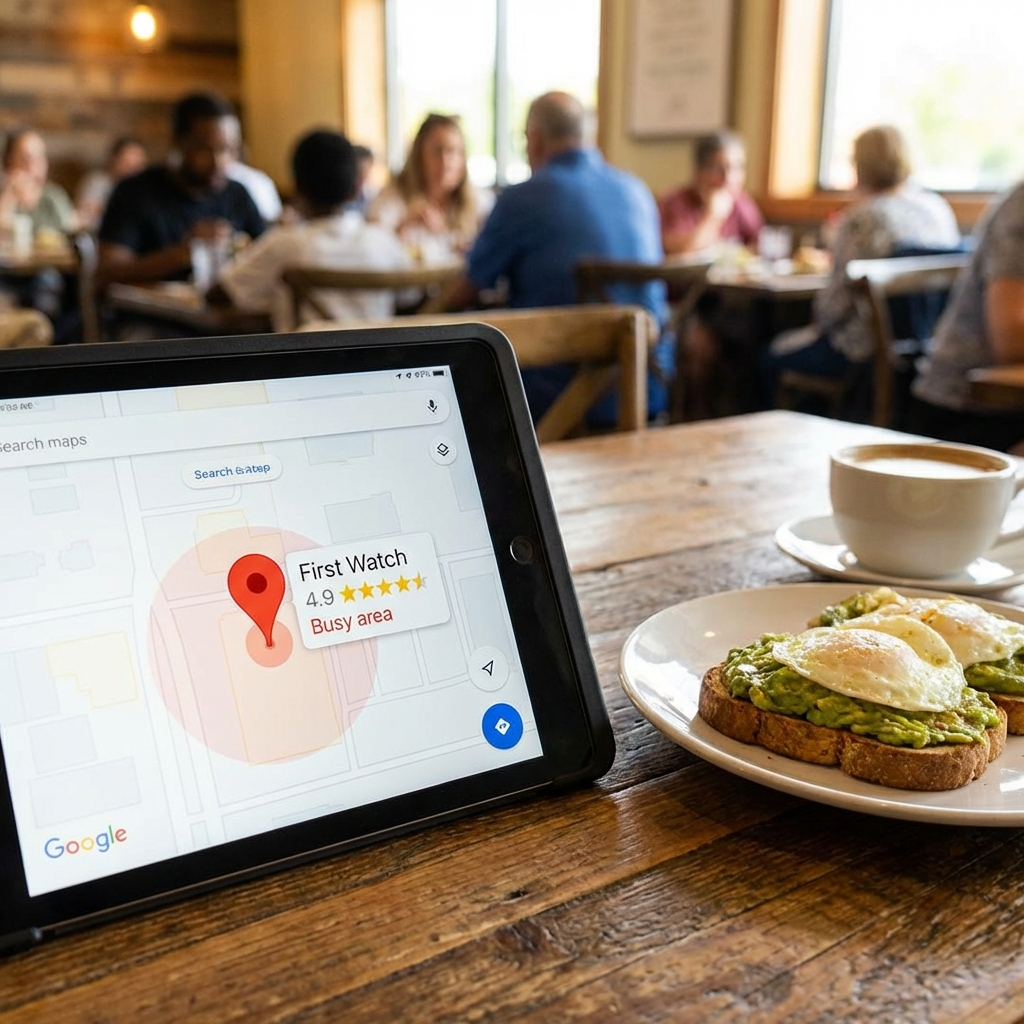
First Watch reported Q4 2025 earnings that beat analyst expectations with GAAP EPS of $0.24. Revenue hit $316 million. Operating margin improved to 2.9%.
But here’s what matters most: same-store sales rose 3.1% year-over-year.
That growth happened while same-restaurant traffic decreased by 1.9%. The company opened 64 new restaurants in 2025 and acquired 19 franchise locations. They now operate 633 restaurants and target a potential footprint of more than 2,200 locations.
The real story sits in their digital marketing test regions. Those areas experienced a several hundred basis point increase in traffic. Management plans a full system rollout in fiscal 2026.
I’ve watched this pattern before. The winners in multi-location restaurant growth understand one principle: local SEO determines who owns the category in each market.
The Local Search Behavior That Drives Restaurant Revenue
Look at the numbers. 98% of customers search online for nearby companies. That’s up from 90% in 2019.
More telling: 76% of “near me” mobile searches lead to a store visit within 24 hours. For restaurants, local search visibility converts to foot traffic the same day.
First Watch’s digital marketing test regions proved this. When you dominate local search results, traffic increases by hundreds of basis points. When you don’t, you’re invisible to the 62% of consumers who use local search results when looking for restaurants.
The restaurant industry will surpass $1.1 trillion in traditional sales in 2026. That’s a 4.1% year-over-year increase. But the brands capturing that growth are the ones who show up first in local search.
Google Business Profile: The Modern Full-Page Ad
I tell clients that an optimized Google Business Profile is the equivalent of a full-page Yellow Pages ad in 1995.
It’s not a comparison. It’s the same strategic position.
Based on a 2025 Malou study of 300+ locations, restaurants optimizing their Google Business Profile get 2.3x more reviews than others and at least 15% more interactions after six months.
Restaurants that actively manage their profile get 70% more engagement on Google. That engagement translates to calls, direction requests, and online orders.
First Watch operates 633 locations. Each location competes in its own local market. Each market has its own search behavior, competition, and customer base. You can’t win 633 local markets with a single corporate website and hope.
You win by optimizing each Google Business Profile. You win by managing reviews at the location level. You win by ensuring every profile has accurate hours, complete service details, and regular updates.
The Multi-Location Challenge First Watch Solved
Managing one Google Business Profile takes discipline. Managing 633 takes a system.
Multi-location restaurant brands face a specific problem. Corporate wants brand consistency. Local managers need flexibility to respond to their market. Customers expect accurate, current information for their specific location.
Most brands fail at this. They either centralize everything and lose local relevance, or they decentralize and lose brand consistency.
First Watch’s digital marketing test regions worked because they solved this problem. They created a system that maintains brand standards while optimizing for local search in each market.
The result: several hundred basis points of traffic increase in test regions. That’s not incremental improvement. That’s category dominance.
Reviews Drive Decisions and Rankings
Here’s what most restaurant operators miss: reviews do double duty.
First, they influence customer decisions. 47% of diners are more likely to visit a restaurant if they see the business responds to reviews. And 88% of potential diners trust online reviews as much or more than word-of-mouth recommendations.
Second, they impact local search rankings. Google’s algorithm factors review quantity, recency, and response rate into local pack rankings.
Research from Harvard Business School shows that a one-star increase in a restaurant’s Yelp rating correlates with a 5-9% increase in revenue.
First Watch’s expansion to 633 locations means they need a review management system that works at scale. You can’t manually monitor and respond to reviews across hundreds of locations. You need automation with human oversight.
The Traffic to Revenue Conversion
Local SEO drives traffic. But traffic only matters if it converts.
First Watch’s same-store sales increased 3.1% while traffic decreased 1.9%. That tells me they’re converting higher-quality customers. Local SEO brings in customers who already decided to visit. They searched for breakfast restaurants near them. They saw First Watch in the local pack. They clicked for directions.
That’s a qualified lead. They’re not browsing. They’re ready to eat.
Compare that to traditional advertising. You pay to interrupt someone’s day and hope they remember your brand when they get hungry. Local SEO captures customers at the moment of intent.
The conversion rate reflects this. 28% of searches for something nearby lead to a purchase. Nearly one in three local retail searches convert to sales.
The 2026 Rollout and What It Means
First Watch plans a full system rollout of their digital marketing strategy in fiscal 2026. They tested it in select regions. It worked. Now they’re scaling it across all 633 locations.
This is how category leaders operate. They test. They measure. They scale what works.
The several hundred basis point traffic increase in test regions will compound across the entire system. That’s not just growth. That’s market share capture from competitors who are still guessing about their marketing.
Over 65% of restaurant searches start on Google Maps or mobile “near me” queries. First Watch is positioning every location to win those searches.
What This Means for Multi-Location Service Brands
First Watch’s strategy applies beyond restaurants. Any multi-location service business faces the same challenge: how do you dominate local search in every market you operate?
The answer is systematic local SEO. You need a centralized system that optimizes each location’s Google Business Profile. You need automated review management that maintains response rates. You need consistent posting across locations while allowing for local customization.
Most importantly, you need measurement. First Watch tested their digital marketing strategy in specific regions before rolling it out system-wide. They measured traffic increases. They tracked conversion rates. They proved ROI before scaling.
That’s strategic marketing. You don’t guess. You test, measure, and scale what works.
The Local SEO Advantage Compounds
Here’s what makes local SEO powerful for multi-location brands: the advantage compounds.
When you rank first in local search, you get more clicks. More clicks lead to more reviews. More reviews improve your rankings. Better rankings bring more clicks.
It’s a reinforcing loop. The brands that establish local search dominance early create a moat that competitors struggle to cross.
First Watch’s 64 new restaurant openings in 2025 benefit from this. Each new location can leverage the brand’s review management system, Google Business Profile optimization, and local SEO strategy from day one.
They’re not starting from zero. They’re starting with a proven system that delivers several hundred basis points of traffic increase.
The Bottom Line
First Watch’s Q4 2025 results show what happens when a multi-location brand gets local SEO right. Same-store sales increased 3.1%. Operating margin improved to 2.9%. Digital marketing test regions experienced several hundred basis points of traffic increase.
The 2026 system-wide rollout will amplify these results across all 633 locations.
This is the pattern I see with category leaders. They recognize that local SEO is the primary discovery mechanism for customers. They build systems to dominate local search in every market they operate. They measure results and scale what works.
The restaurant industry will generate $1.1 trillion in sales in 2026. The brands capturing that growth are the ones who show up first when customers search for restaurants near them.
Local SEO determines who owns the category. First Watch proved it in their test regions. Now they’re scaling it across their entire system.
That’s how you win in multi-location service businesses. You don’t compete on price or hope. You compete on visibility. You own local search in every market you operate. My BrandCommand Franchise Marketing System can do this for you. Book a demo and see for yourself: https://bookmenow.info/book/bill-jackman/brandcommand-demo
Every service business owner faces the same question right now: Will AI replace the human element in marketing?
The answer surprises most people.
AI automation makes human connection more valuable, not less. I’ve promoted relational marketing for 25 years, and I’ve never seen a moment where authentic relationships mattered more than they do today.
The Efficiency Paradox Nobody Talks About
Here’s what’s happening in 2026.
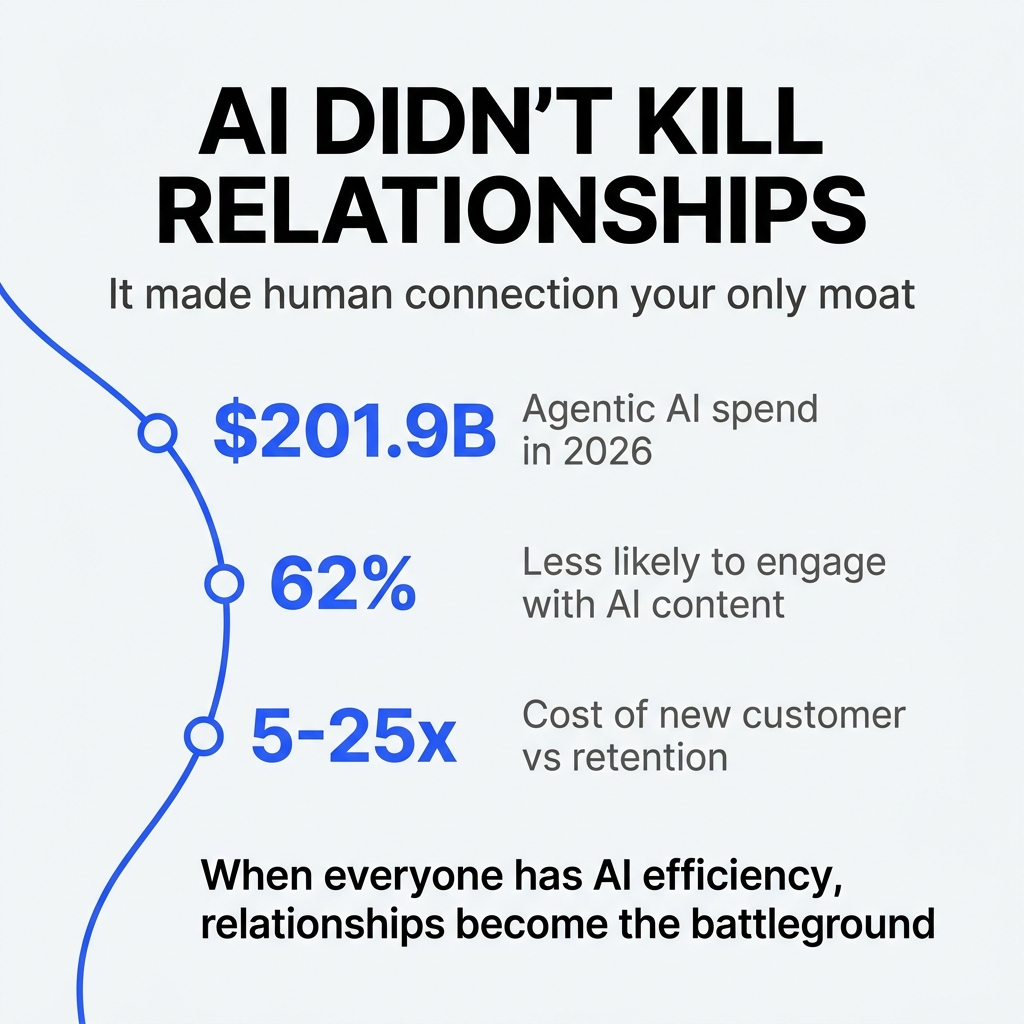
Agentic AI spending reaches $201.9 billion this year. By the end of 2026, 40% of enterprise applications will embed AI agents, up from less than 5% in 2025.
Virtually all successful advertisers now rely on automation. It’s table stakes.
When everyone has access to the same AI tools, efficiency itself becomes commoditized. You can’t win on automation alone anymore because your competitors have the same capabilities.
The battleground shifts.
What AI Can’t Replicate
The data tells a clear story about consumer trust.
About 62% of consumers are less likely to engage with content when they know AI generated it. Half of consumers can correctly identify AI-generated copy. When they suspect content came from an algorithm, 52% become less engaged.
Trust isn’t a soft brand value anymore. It’s a measurable performance constraint.
Your service business has something AI can never replicate: face-to-face relationships built during actual service delivery. Every interaction with a customer becomes a competitive moat that purely digital competitors can’t cross.
The IBC Framework Changes Everything
I work with service businesses to identify their Ideal Brand Clients (IBCs). These customers make your staff happier when they walk through the door.
IBCs have a low PITA factor. That’s pain-in-the-ass factor, measured on a 1-5 scale.
They spend more. They visit more frequently. They value your staff’s contribution. When something goes wrong, they’re forgiving because the relationship matters more than a single transaction.
Then you have Less Than Ideals (LTIs). They consume 80% of your staff’s time but generate only 20% of your revenue. They chase your lowest price. They have zero loyalty. When problems arise, they broadcast complaints everywhere.
Here’s the strategic move: Use AI to filter out LTIs before they become your problem. Let them drain your competitors’ resources instead.
When you focus staff energy on IBCs, turnover drops. Service quality improves. Your team becomes your competitive advantage.
How Relationship Intelligence Trains Better AI
Businesses that built strong relationships before AI arrived now have a massive advantage.
They know their IBCs deeply. They understand the detailed history of these customers in their local market. They know how IBCs feel about the brand and services.
This relationship knowledge makes AI outputs more authentic. More human.
A business guessing at their audience produces generic AI content. A business with relationship intelligence produces AI content that resonates because it’s grounded in real customer understanding.
The difference shows up in conversion rates.
Local Presence as Strategic Moat
Acquiring a new customer costs 5 to 25 times more than retaining an existing one. Customer acquisition costs rose approximately 60-75% for both B2C and B2B businesses from 2014 to 2019.
When multiple businesses in a market use AI to hunt the same IBCs, proof of genuine relationships wins.
Reputation matters. Reviews matter. Awards matter. Community recognition matters. Sponsorships matter.
These elements create barriers to entry that AI alone can’t overcome.
For multi-location businesses, this becomes systematic. Each location builds hyper-local proof through local website presence, citations, photos, and stories. You’re not creating corporate-manufactured community involvement. You’re spotlighting local people working in your business, sharing what’s happening in the neighborhood, celebrating the people and events in close proximity to each location.
I call this Connected Hyper Local Marketing. It’s the winning strategy for franchises and multi-location operators.
The Brand Identity Shift
My dentist of 35 years recently retired. I only saw him once a year, but I knew he looked after my dental health to the best of his abilities.
That relationship made me feel like someone who looks after his dental health to the best of his abilities.
The brand became part of my identity.
This works for any service business. Your plumber. Your HVAC company. Your physiotherapist. When customers define themselves through their relationship with your brand, price becomes secondary.
AI handles the acquisition mechanics. Humans build the identity connection.
The Division of Labor That Wins
AI excels at efficiency. It automates customer acquisition, manages reviews, optimizes local SEO, and runs conversion campaigns around the clock.
This efficiency frees your team to focus on what AI can’t do: building trust during face-to-face service delivery, creating genuine community connections, and turning customers into people who identify with your brand.
The businesses winning in 2026 use AI as a filter and amplifier. They filter out LTIs. They amplify their local presence. They systematize relationship building across locations.
They don’t replace human connection. They create more space for it.
What This Means for Your Business
You need to make a choice.
You can chase efficiency alone and compete with everyone else who has the same AI tools. Or you can use AI to free up resources for the relationship building that creates actual competitive advantage.
Define your IBCs. Measure their PITA factor. Use AI to attract more of them and repel LTIs. Build systematic local presence across your locations. Train your AI with relationship intelligence, not guesswork.
The pendulum swung from transactional to relational marketing. AI didn’t cause this shift. It accelerated it.
In a sea of automation, human connection becomes your most valuable asset.
The question isn’t whether AI will replace relationships. The question is whether you’ll use AI to build deeper ones.
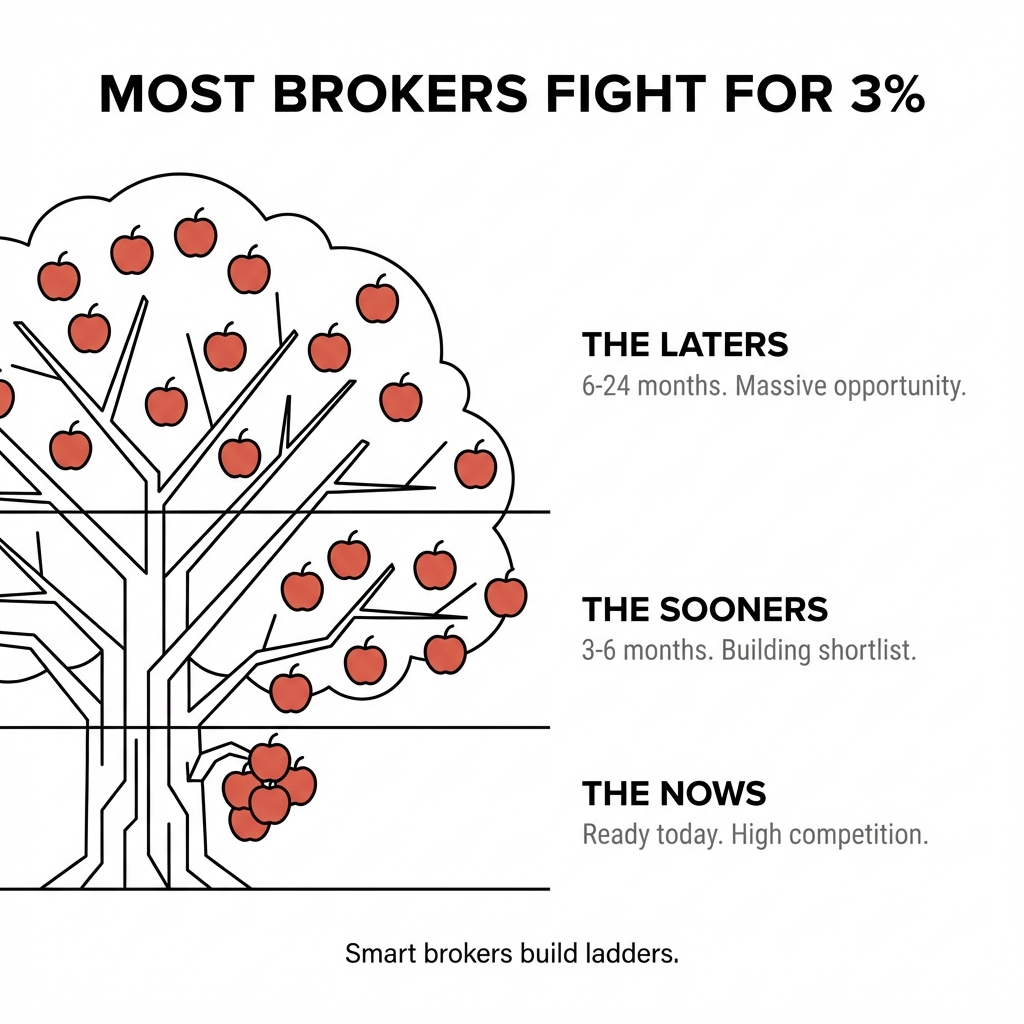
Most mortgage brokers are fighting over the same 3% of homebuyers who are ready to close next week.
Meanwhile, 93% of Gen Z still wants to own homes someday. But they’re not calling mom and dad for broker referrals anymore.
The referral networks that built careers over decades are fragmenting. Families are scattered. Gen Z homebuying patterns show they research independently, judge you by your Google reviews, and make decisions based on social proof rather than family recommendations.
This creates a fundamental problem. Every broker is chasing the same “now” buyers while ignoring the massive pipeline of future clients.
The Apple Tree Problem
Think of your market like an apple tree.
Most brokers are jumping for the low-hanging fruit. The ready-to-buy-today clients on the bottom branches. Everyone sees those apples. Everyone fights for them.
But the real harvest is in the middle and top of the tree. The prospects who won’t buy for 6, 12, or 18 months. The ones doing early research, comparing options, building trust over time.
Smart brokers build ladders. They create systems to reach the entire tree.
The Nows, Sooners, Laters Framework
I break every prospect pipeline into three categories:
The Nows: Ready to buy immediately. Every broker fights over these. High competition, low margins, stressful closes.
The Sooners: Actively researching, comparing options. Timeline is 3-6 months. They’re building their short list.
The Laters: Early awareness stage. They know they want to buy someday but haven’t committed to a timeline. Could be 6-24 months out.
Most brokers only see the Nows. They spend all their marketing budget competing for immediate buyers.
The winning strategy captures all three categories. When your Laters become Sooners, and your Sooners become Nows, you’re already their trusted guide.
Why AI Changes Everything
The search behavior shift is happening faster than most brokers realize.
Traditional search behavior shift data shows search engine volume will drop 25% by 2026. Gen Z prospects are asking AI assistants questions instead of scrolling through broker websites.
This creates opportunity for brokers who adapt early.
AI-driven systems can handle the qualification and nurturing that used to require manual follow-up. AI automation benefits include 30-50% reduction in time spent on routine inquiries.
Your AI webchat captures the 11 PM question: “Can I afford a house with student loans?”
Your AI voice receptionist books qualification calls while you sleep.
Your automated email sequences keep you top-of-mind during the 18-month research process.
The Chickening Out Period
Here’s what most vendors won’t tell you: the first 12-14 weeks are rough.
You’ll feel upside down. You’ll question the investment. You’ll wonder if the old way was better.
I call this the chickening out period. Every broker goes through it.
The difference between success and failure is pushing through those first three months. That’s when the system starts learning, your rankings improve, and the pipeline begins filling with qualified prospects.
You’re not just building a marketing system. You’re building a competitive moat.
The Hockey Stick Reality
AI adoption follows a hockey stick curve. Slow at first, then exponential.
In the next 3-5 years, every serious mortgage broker will be using AI-driven marketing systems. The question is whether you’ll be early or late to the party.
Early adopters capture market share while competitors are still manually qualifying leads and chasing referrals from retired networks.
Late adopters find themselves competing against brokers who have 18-month head starts on pipeline development and client education.
Building Your Ladder
The winning brokers are already building unified AI systems that capture anonymous website visitors and nurture them through the entire buying journey.
They’re optimizing Google Business Profiles to show up in AI search summaries.
They’re creating content that educates Gen Z prospects about avoiding their parents’ financial mistakes.
They’re setting up automated review management and reputation systems.
Most importantly, they’re thinking in quarters instead of weeks. They’re playing the long game while competitors fight over scraps.
The mortgage industry is splitting into two groups: brokers who harvest the whole tree, and brokers who keep jumping for the same low-hanging fruit.
Which group will you choose?
I keep hearing the same advice from experienced marketing people: “Build one corporate website with location pages. Simpler. Cheaper. Easier to manage.”
On paper, this sounds reasonable.
Here’s what I’ve learned after years of watching service-based franchises struggle with local visibility: the advice costs you customers.
The truth is more uncomfortable than most franchisors want to admit. A centralized corporate website with location pages fails both the brand and the market. Looks organized in a boardroom presentation, underperforms where things matter… local search results, AI recommendations, and the minds of customers searching for help right now.
The Problem With Location Pages Nobody Talks About
Location pages feel efficient. One site. One domain. One content management system. Clean org chart. Tidy budget line. I get the appeal.
Search engines and AI systems don’t reward organizational tidiness.
They reward entity-level clarity.
When you bury a location under a corporate URL structure, you’re sending a weak signal. Telling Google, ChatGPT, and every other discovery platform this location is subordinate. A branch office. An afterthought.
And that’s exactly how those systems treat it.
Here’s what’s happening: 40.16% of local business queries now trigger Google’s AI Overviews. When someone searches for a service near them, they see an AI-generated answer before traditional search results. AI systems think in terms of distinct entities. Your business, its owner, services, location, and products are all separate entities needing clear mapping.
Location page on a corporate site? Fuzzy signal.
Dedicated website for each location? Clear entity with local authority, local intent, and local relevance.
Markets reward presence. Not permission.
What AI Search Means for Your Local Visibility
Most franchise marketers haven’t realized this yet: 60% to 70% of local results on ChatGPT come straight from Foursquare’s city guide listings.
A customer might see you at #1 in Google Maps, then ask ChatGPT for advice and get a completely different recommendation. Or Google AI Overviews might summarize local options without including your business, even though you rank well in traditional search.
This changes the game. You’re no longer competing for Google rankings. You’re competing to be the AI’s recommendation.
AI systems don’t think in sitemap hierarchies. They think in distinct businesses with clear signals.
A standalone site has:
- Its own authority
- Its own content graph
- Its own review and citation ecosystem
This matters more as AI replaces traditional search behavior.
The “Near Me” Reality Your Corporate Site Can’t Solve
1.5 billion searches each month include “near me.”
46% of people say they often include “near me” in their search queries. Even more compelling: 88% of consumers who conduct a local search on their smartphone visit or call a store within a day.
Not browsing behavior. Buying behavior.
Those searches reveal something: customers want a local business, not a corporate entity with local branches.
When your location exists only as a page on a corporate site, you’re asking customers to mentally translate. “Is this a local business? Or am I dealing with a call center? Will I get someone who knows my area?”
A dedicated site answers those questions immediately. Signals: real local business. Local authority. Local intent.
The critical distinction: a location page is similar to a service area page. The main difference is the business has a physical location in the market. If your business serves multiple areas, you need dedicated landing pages for each one with 100% unique content. As long as your content is unique and you genuinely serve the area, these location pages help you rank in local organic results and drive high-converting traffic.
Many law firms and multi-location service businesses have learned this: you see higher engagement and conversion rates when you add targeted location pages to your website. The performance gap between generic corporate pages and dedicated local presence is measurable and significant.
The Google Business Profile Multiplier Effect
Customers are 2.7 times more likely to consider a business reputable if they have a complete business profile on Google Search and Maps.
They’re 70% more likely to visit and 50% more likely to consider purchasing.
What most franchisors miss: you need a separate, fully optimized Google Business Profile for each location. Your website should have a unique, dedicated location page for each branch with specific content, NAP (name, address, phone), and a map.
Do not lump all your locations onto a single contact page.
This destroys the multiplier effect. Each location needs its own digital footprint reinforcing its Google Business Profile. When you have a dedicated website for each location, you create a reinforcing loop:
- The website strengthens the Google Business Profile
- The profile drives traffic to the website
- Both signal to AI systems this is a distinct, authoritative local business
This isn’t theory. This is how local search works in 2025.
The Control Versus Performance Trap
I understand why franchisors default to corporate-only sites. It’s not because they work better. It’s because they feel safer organizationally.
The fear is real: franchisees usually stray more often from brand guidelines, causing inconsistent customer experiences. When local teams do the majority of the work, it’s easier for disconnect in the chain.
The strategic error in this thinking: you’re choosing control without performance.
The alternative isn’t chaos. It’s governed autonomy.
The most successful franchise marketers use a hub-and-spoke model. The franchisor acts as the hub, setting brand guidelines, providing tools, and supplying creative assets. Franchisees act as spokes, tailoring campaigns to their local markets.
Brand-level controls enable corporate marketing teams to provide and lock down ad creative, copy, and other strategic parts of a campaign. This maintains brand integrity while reducing the risk of errors.
This isn’t controlled decentralization. This is sophisticated execution. Period.
Franchise digital marketing requires balance: centralized strategy and localized execution. You craft campaigns upholding the corporate brand’s vision while allowing individual franchise locations flexibility to connect with their unique markets.
What Governed Autonomy Looks Like
A dedicated site for each location allows:
- Local testimonials
- Local offers
- Local service emphasis
- Local language and tone
Impossible to do properly on templated location pages without bloating or diluting the corporate site.
The result: franchisees don’t feel like branch offices. They feel like market owners.
What happens when franchisees have a direct stake in their digital footprint: they perform better. A dedicated site gives franchisees ownership, makes performance visible, and enables benchmarking between locations.
This supports coaching, accountability, and growth conversations.
A corporate site hides underperformance. Distributed sites expose it.
The Execution Risk You Can’t Ignore
I need to be honest about the weakness in this model: it only works with a system.
Multiple sites mean more hosting, more updates, more QA, more governance. Governance fails, you get brand drift, technical inconsistency, and maintenance overhead.
Without proper tooling, this becomes unmanageable. You need:
- Shared templates
- Central visibility
- Automated compliance
- Performance dashboards
Without these elements, critics will say, “This is why we centralized everything.” They’ll be right.
The model collapses under its own weight when you try to run it manually.
When you have the right system in place, the performance advantage is undeniable. You get control and performance. Not one or the other.
The Real Choice Franchisors Face
The person who told me “a centralized head office website with location pages is better” wasn’t wrong in a vacuum. They’re right for organizations without systems.
The idea of dedicated, governed local sites are superior when governance is baked in.
Here’s the real distinction:
Centralized site = control without performance
Ungoverned local sites = performance without control
Governed local sites = control and performance
The third option didn’t exist at scale before. Now the option does.
You’re not choosing between centralization and localization. You’re choosing a system giving you both.
In a world where AI search is changing local discovery, where “near me” searches dominate local intent, and where customers are 2.7 times more likely to trust businesses with complete local profiles, the performance gap between corporate location pages and dedicated local sites will only widen.
The question isn’t whether dedicated sites perform better. Spoiler: they do.
The question is whether you have the system to execute them properly.
If you don’t, the skeptics are right. Stick with what you have.
If you’re ready to compete in the market as things exist today, where AI recommendations matter, where local signals determine visibility, and where customers reward presence over permission, then rethink your digital strategy.
Your franchisees deserve to compete like market owners, not branch offices.
And your customers deserve to find you when they search.