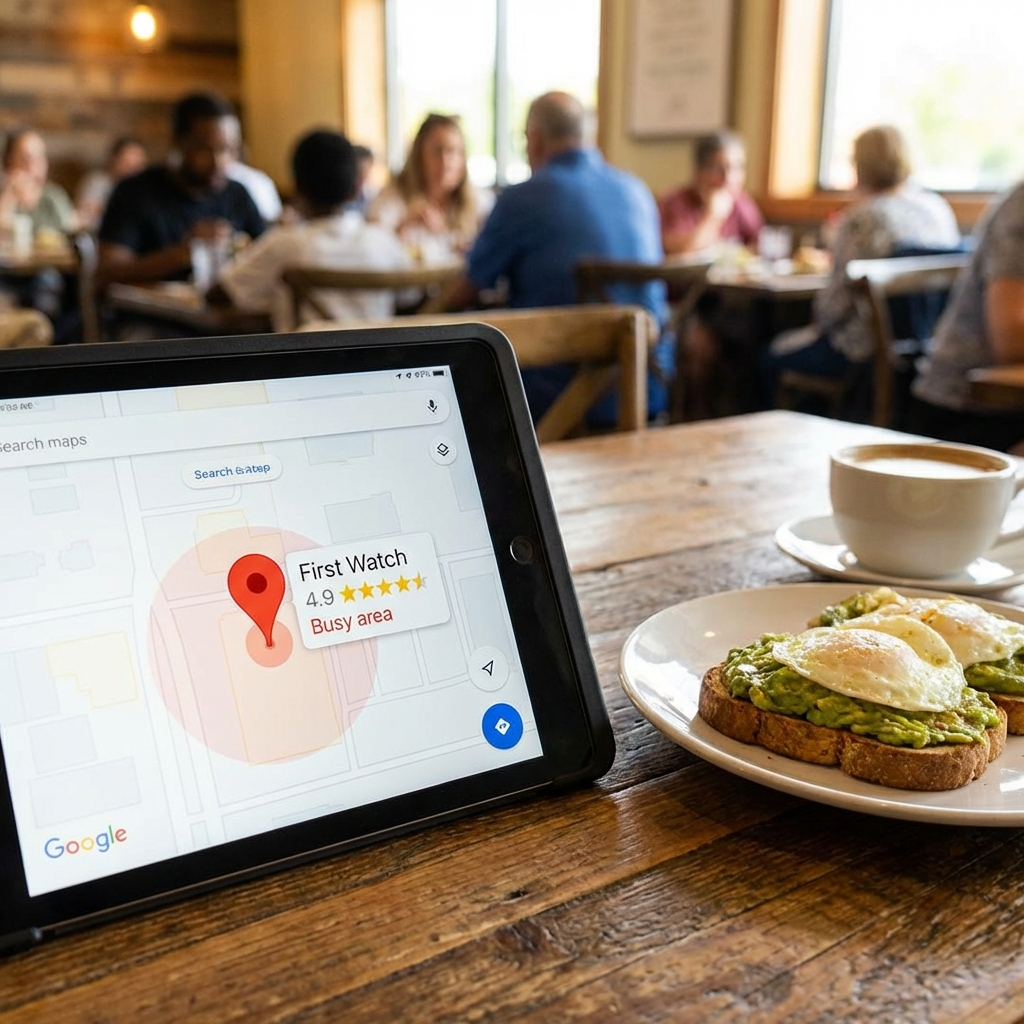
What First Watch’s Growth Strategy Teaches Multi-Location Brands About Local SEO

Test Gadget Preview Image

First Watch reported Q4 2025 earnings that beat analyst expectations with GAAP EPS of $0.24. Revenue hit $316 million. Operating margin improved to 2.9%.

But here’s what matters most: same-store sales rose 3.1% year-over-year.

That growth happened while same-restaurant traffic decreased by 1.9%. The company opened 64 new restaurants in 2025 and acquired 19 franchise locations. They now operate 633 restaurants and target a potential footprint of more than 2,200 locations.

The real story sits in their digital marketing test regions. Those areas experienced a several hundred basis point increase in traffic. Management plans a full system rollout in fiscal 2026.

I’ve watched this pattern before. The winners in multi-location restaurant growth understand one principle: local SEO determines who owns the category in each market.

The Local Search Behavior That Drives Restaurant Revenue

Look at the numbers. 98% of customers search online for nearby companies. That’s up from 90% in 2019.

More telling: 76% of “near me” mobile searches lead to a store visit within 24 hours. For restaurants, local search visibility converts to foot traffic the same day.

First Watch’s digital marketing test regions proved this. When you dominate local search results, traffic increases by hundreds of basis points. When you don’t, you’re invisible to the 62% of consumers who use local search results when looking for restaurants.

The restaurant industry will surpass $1.1 trillion in traditional sales in 2026. That’s a 4.1% year-over-year increase. But the brands capturing that growth are the ones who show up first in local search.

Google Business Profile: The Modern Full-Page Ad

I tell clients that an optimized Google Business Profile is the equivalent of a full-page Yellow Pages ad in 1995.

It’s not a comparison. It’s the same strategic position.

Based on a 2025 Malou study of 300+ locations, restaurants optimizing their Google Business Profile get 2.3x more reviews than others and at least 15% more interactions after six months.

Restaurants that actively manage their profile get 70% more engagement on Google. That engagement translates to calls, direction requests, and online orders.

First Watch operates 633 locations. Each location competes in its own local market. Each market has its own search behavior, competition, and customer base. You can’t win 633 local markets with a single corporate website and hope.

You win by optimizing each Google Business Profile. You win by managing reviews at the location level. You win by ensuring every profile has accurate hours, complete service details, and regular updates.

The Multi-Location Challenge First Watch Solved

Managing one Google Business Profile takes discipline. Managing 633 takes a system.

Multi-location restaurant brands face a specific problem. Corporate wants brand consistency. Local managers need flexibility to respond to their market. Customers expect accurate, current information for their specific location.

Most brands fail at this. They either centralize everything and lose local relevance, or they decentralize and lose brand consistency.

First Watch’s digital marketing test regions worked because they solved this problem. They created a system that maintains brand standards while optimizing for local search in each market.

The result: several hundred basis points of traffic increase in test regions. That’s not incremental improvement. That’s category dominance.

Reviews Drive Decisions and Rankings

Here’s what most restaurant operators miss: reviews do double duty.

First, they influence customer decisions. 47% of diners are more likely to visit a restaurant if they see the business responds to reviews. And 88% of potential diners trust online reviews as much or more than word-of-mouth recommendations.

Second, they impact local search rankings. Google’s algorithm factors review quantity, recency, and response rate into local pack rankings.

Research from Harvard Business School shows that a one-star increase in a restaurant’s Yelp rating correlates with a 5-9% increase in revenue.

First Watch’s expansion to 633 locations means they need a review management system that works at scale. You can’t manually monitor and respond to reviews across hundreds of locations. You need automation with human oversight.

The Traffic to Revenue Conversion

Local SEO drives traffic. But traffic only matters if it converts.

First Watch’s same-store sales increased 3.1% while traffic decreased 1.9%. That tells me they’re converting higher-quality customers. Local SEO brings in customers who already decided to visit. They searched for breakfast restaurants near them. They saw First Watch in the local pack. They clicked for directions.

That’s a qualified lead. They’re not browsing. They’re ready to eat.

Compare that to traditional advertising. You pay to interrupt someone’s day and hope they remember your brand when they get hungry. Local SEO captures customers at the moment of intent.

The conversion rate reflects this. 28% of searches for something nearby lead to a purchase. Nearly one in three local retail searches convert to sales.

The 2026 Rollout and What It Means

First Watch plans a full system rollout of their digital marketing strategy in fiscal 2026. They tested it in select regions. It worked. Now they’re scaling it across all 633 locations.

This is how category leaders operate. They test. They measure. They scale what works.

The several hundred basis point traffic increase in test regions will compound across the entire system. That’s not just growth. That’s market share capture from competitors who are still guessing about their marketing.

Over 65% of restaurant searches start on Google Maps or mobile “near me” queries. First Watch is positioning every location to win those searches.

What This Means for Multi-Location Service Brands

First Watch’s strategy applies beyond restaurants. Any multi-location service business faces the same challenge: how do you dominate local search in every market you operate?

The answer is systematic local SEO. You need a centralized system that optimizes each location’s Google Business Profile. You need automated review management that maintains response rates. You need consistent posting across locations while allowing for local customization.

Most importantly, you need measurement. First Watch tested their digital marketing strategy in specific regions before rolling it out system-wide. They measured traffic increases. They tracked conversion rates. They proved ROI before scaling.

That’s strategic marketing. You don’t guess. You test, measure, and scale what works.

The Local SEO Advantage Compounds

Here’s what makes local SEO powerful for multi-location brands: the advantage compounds.

When you rank first in local search, you get more clicks. More clicks lead to more reviews. More reviews improve your rankings. Better rankings bring more clicks.

It’s a reinforcing loop. The brands that establish local search dominance early create a moat that competitors struggle to cross.

First Watch’s 64 new restaurant openings in 2025 benefit from this. Each new location can leverage the brand’s review management system, Google Business Profile optimization, and local SEO strategy from day one.

They’re not starting from zero. They’re starting with a proven system that delivers several hundred basis points of traffic increase.

The Bottom Line

First Watch’s Q4 2025 results show what happens when a multi-location brand gets local SEO right. Same-store sales increased 3.1%. Operating margin improved to 2.9%. Digital marketing test regions experienced several hundred basis points of traffic increase.

The 2026 system-wide rollout will amplify these results across all 633 locations.

This is the pattern I see with category leaders. They recognize that local SEO is the primary discovery mechanism for customers. They build systems to dominate local search in every market they operate. They measure results and scale what works.

The restaurant industry will generate $1.1 trillion in sales in 2026. The brands capturing that growth are the ones who show up first when customers search for restaurants near them.

Local SEO determines who owns the category. First Watch proved it in their test regions. Now they’re scaling it across their entire system.

That’s how you win in multi-location service businesses. You don’t compete on price or hope. You compete on visibility. You own local search in every market you operate. My BrandCommand Franchise Marketing System can do this for you. Book a demo and see for yourself: https://bookmenow.info/book/bill-jackman/brandcommand-demo

Why AI Marketing Makes Human Connection Your Competitive Weapon

Test Gadget Preview Image

Every service business owner faces the same question right now: Will AI replace the human element in marketing?

The answer surprises most people.

AI automation makes human connection more valuable, not less. I’ve promoted relational marketing for 25 years, and I’ve never seen a moment where authentic relationships mattered more than they do today.

The Efficiency Paradox Nobody Talks About

Here’s what’s happening in 2026.

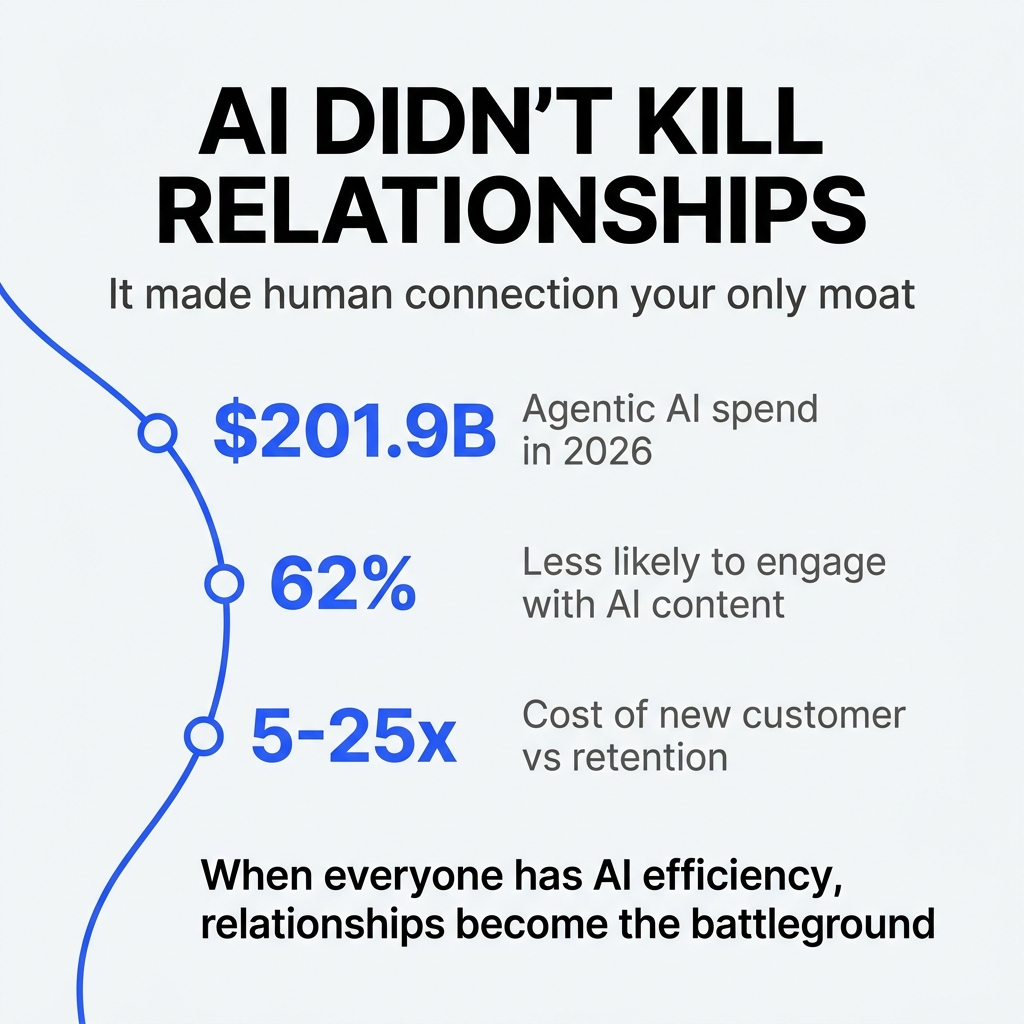
Agentic AI spending reaches $201.9 billion this year. By the end of 2026, 40% of enterprise applications will embed AI agents, up from less than 5% in 2025.

Virtually all successful advertisers now rely on automation. It’s table stakes.

When everyone has access to the same AI tools, efficiency itself becomes commoditized. You can’t win on automation alone anymore because your competitors have the same capabilities.

The battleground shifts.

What AI Can’t Replicate

The data tells a clear story about consumer trust.

About 62% of consumers are less likely to engage with content when they know AI generated it. Half of consumers can correctly identify AI-generated copy. When they suspect content came from an algorithm, 52% become less engaged.

Trust isn’t a soft brand value anymore. It’s a measurable performance constraint.

Your service business has something AI can never replicate: face-to-face relationships built during actual service delivery. Every interaction with a customer becomes a competitive moat that purely digital competitors can’t cross.

The IBC Framework Changes Everything

I work with service businesses to identify their Ideal Brand Clients (IBCs). These customers make your staff happier when they walk through the door.

IBCs have a low PITA factor. That’s pain-in-the-ass factor, measured on a 1-5 scale.

They spend more. They visit more frequently. They value your staff’s contribution. When something goes wrong, they’re forgiving because the relationship matters more than a single transaction.

Then you have Less Than Ideals (LTIs). They consume 80% of your staff’s time but generate only 20% of your revenue. They chase your lowest price. They have zero loyalty. When problems arise, they broadcast complaints everywhere.

Here’s the strategic move: Use AI to filter out LTIs before they become your problem. Let them drain your competitors’ resources instead.

When you focus staff energy on IBCs, turnover drops. Service quality improves. Your team becomes your competitive advantage.

How Relationship Intelligence Trains Better AI

Businesses that built strong relationships before AI arrived now have a massive advantage.

They know their IBCs deeply. They understand the detailed history of these customers in their local market. They know how IBCs feel about the brand and services.

This relationship knowledge makes AI outputs more authentic. More human.

A business guessing at their audience produces generic AI content. A business with relationship intelligence produces AI content that resonates because it’s grounded in real customer understanding.

The difference shows up in conversion rates.

Local Presence as Strategic Moat

Acquiring a new customer costs 5 to 25 times more than retaining an existing one. Customer acquisition costs rose approximately 60-75% for both B2C and B2B businesses from 2014 to 2019.

When multiple businesses in a market use AI to hunt the same IBCs, proof of genuine relationships wins.

Reputation matters. Reviews matter. Awards matter. Community recognition matters. Sponsorships matter.

These elements create barriers to entry that AI alone can’t overcome.

For multi-location businesses, this becomes systematic. Each location builds hyper-local proof through local website presence, citations, photos, and stories. You’re not creating corporate-manufactured community involvement. You’re spotlighting local people working in your business, sharing what’s happening in the neighborhood, celebrating the people and events in close proximity to each location.

I call this Connected Hyper Local Marketing. It’s the winning strategy for franchises and multi-location operators.

The Brand Identity Shift

My dentist of 35 years recently retired. I only saw him once a year, but I knew he looked after my dental health to the best of his abilities.

That relationship made me feel like someone who looks after his dental health to the best of his abilities.

The brand became part of my identity.

This works for any service business. Your plumber. Your HVAC company. Your physiotherapist. When customers define themselves through their relationship with your brand, price becomes secondary.

AI handles the acquisition mechanics. Humans build the identity connection.

The Division of Labor That Wins

AI excels at efficiency. It automates customer acquisition, manages reviews, optimizes local SEO, and runs conversion campaigns around the clock.

This efficiency frees your team to focus on what AI can’t do: building trust during face-to-face service delivery, creating genuine community connections, and turning customers into people who identify with your brand.

The businesses winning in 2026 use AI as a filter and amplifier. They filter out LTIs. They amplify their local presence. They systematize relationship building across locations.

They don’t replace human connection. They create more space for it.

What This Means for Your Business

You need to make a choice.

You can chase efficiency alone and compete with everyone else who has the same AI tools. Or you can use AI to free up resources for the relationship building that creates actual competitive advantage.

Define your IBCs. Measure their PITA factor. Use AI to attract more of them and repel LTIs. Build systematic local presence across your locations. Train your AI with relationship intelligence, not guesswork.

The pendulum swung from transactional to relational marketing. AI didn’t cause this shift. It accelerated it.

In a sea of automation, human connection becomes your most valuable asset.

The question isn’t whether AI will replace relationships. The question is whether you’ll use AI to build deeper ones.

Why Your Franchise’s Corporate Website Is Losing You Local Business

I keep hearing the same advice from experienced marketing people: “Build one corporate website with location pages. Simpler. Cheaper. Easier to manage.”

On paper, this sounds reasonable.

Here’s what I’ve learned after years of watching service-based franchises struggle with local visibility: the advice costs you customers.

The truth is more uncomfortable than most franchisors want to admit. A centralized corporate website with location pages fails both the brand and the market. Looks organized in a boardroom presentation, underperforms where things matter… local search results, AI recommendations, and the minds of customers searching for help right now.


The Problem With Location Pages Nobody Talks About

Location pages feel efficient. One site. One domain. One content management system. Clean org chart. Tidy budget line. I get the appeal.

Search engines and AI systems don’t reward organizational tidiness.

They reward entity-level clarity.

When you bury a location under a corporate URL structure, you’re sending a weak signal. Telling Google, ChatGPT, and every other discovery platform this location is subordinate. A branch office. An afterthought.

And that’s exactly how those systems treat it.

Here’s what’s happening: 40.16% of local business queries now trigger Google’s AI Overviews. When someone searches for a service near them, they see an AI-generated answer before traditional search results. AI systems think in terms of distinct entities. Your business, its owner, services, location, and products are all separate entities needing clear mapping.

Location page on a corporate site? Fuzzy signal.

Dedicated website for each location? Clear entity with local authority, local intent, and local relevance.

Markets reward presence. Not permission.


What AI Search Means for Your Local Visibility

Most franchise marketers haven’t realized this yet: 60% to 70% of local results on ChatGPT come straight from Foursquare’s city guide listings.

A customer might see you at #1 in Google Maps, then ask ChatGPT for advice and get a completely different recommendation. Or Google AI Overviews might summarize local options without including your business, even though you rank well in traditional search.

This changes the game. You’re no longer competing for Google rankings. You’re competing to be the AI’s recommendation.

AI systems don’t think in sitemap hierarchies. They think in distinct businesses with clear signals.

A standalone site has:

  • Its own authority
  • Its own content graph
  • Its own review and citation ecosystem

This matters more as AI replaces traditional search behavior.


The “Near Me” Reality Your Corporate Site Can’t Solve

1.5 billion searches each month include “near me.”

46% of people say they often include “near me” in their search queries. Even more compelling: 88% of consumers who conduct a local search on their smartphone visit or call a store within a day.

Not browsing behavior. Buying behavior.

Those searches reveal something: customers want a local business, not a corporate entity with local branches.

When your location exists only as a page on a corporate site, you’re asking customers to mentally translate. “Is this a local business? Or am I dealing with a call center? Will I get someone who knows my area?”

A dedicated site answers those questions immediately. Signals: real local business. Local authority. Local intent.

The critical distinction: a location page is similar to a service area page. The main difference is the business has a physical location in the market. If your business serves multiple areas, you need dedicated landing pages for each one with 100% unique content. As long as your content is unique and you genuinely serve the area, these location pages help you rank in local organic results and drive high-converting traffic.

Many law firms and multi-location service businesses have learned this: you see higher engagement and conversion rates when you add targeted location pages to your website. The performance gap between generic corporate pages and dedicated local presence is measurable and significant.


The Google Business Profile Multiplier Effect

Customers are 2.7 times more likely to consider a business reputable if they have a complete business profile on Google Search and Maps.

They’re 70% more likely to visit and 50% more likely to consider purchasing.

What most franchisors miss: you need a separate, fully optimized Google Business Profile for each location. Your website should have a unique, dedicated location page for each branch with specific content, NAP (name, address, phone), and a map.

Do not lump all your locations onto a single contact page.

This destroys the multiplier effect. Each location needs its own digital footprint reinforcing its Google Business Profile. When you have a dedicated website for each location, you create a reinforcing loop:

  • The website strengthens the Google Business Profile
  • The profile drives traffic to the website
  • Both signal to AI systems this is a distinct, authoritative local business

This isn’t theory. This is how local search works in 2025.


The Control Versus Performance Trap

I understand why franchisors default to corporate-only sites. It’s not because they work better. It’s because they feel safer organizationally.

The fear is real: franchisees usually stray more often from brand guidelines, causing inconsistent customer experiences. When local teams do the majority of the work, it’s easier for disconnect in the chain.

The strategic error in this thinking: you’re choosing control without performance.

The alternative isn’t chaos. It’s governed autonomy.

The most successful franchise marketers use a hub-and-spoke model. The franchisor acts as the hub, setting brand guidelines, providing tools, and supplying creative assets. Franchisees act as spokes, tailoring campaigns to their local markets.

Brand-level controls enable corporate marketing teams to provide and lock down ad creative, copy, and other strategic parts of a campaign. This maintains brand integrity while reducing the risk of errors.

This isn’t controlled decentralization. This is sophisticated execution. Period.

Franchise digital marketing requires balance: centralized strategy and localized execution. You craft campaigns upholding the corporate brand’s vision while allowing individual franchise locations flexibility to connect with their unique markets.


What Governed Autonomy Looks Like

A dedicated site for each location allows:

  • Local testimonials
  • Local offers
  • Local service emphasis
  • Local language and tone

Impossible to do properly on templated location pages without bloating or diluting the corporate site.

The result: franchisees don’t feel like branch offices. They feel like market owners.

What happens when franchisees have a direct stake in their digital footprint: they perform better. A dedicated site gives franchisees ownership, makes performance visible, and enables benchmarking between locations.

This supports coaching, accountability, and growth conversations.

A corporate site hides underperformance. Distributed sites expose it.


The Execution Risk You Can’t Ignore

I need to be honest about the weakness in this model: it only works with a system.

Multiple sites mean more hosting, more updates, more QA, more governance. Governance fails, you get brand drift, technical inconsistency, and maintenance overhead.

Without proper tooling, this becomes unmanageable. You need:

  • Shared templates
  • Central visibility
  • Automated compliance
  • Performance dashboards

Without these elements, critics will say, “This is why we centralized everything.” They’ll be right.

The model collapses under its own weight when you try to run it manually.

When you have the right system in place, the performance advantage is undeniable. You get control and performance. Not one or the other.


The Real Choice Franchisors Face

The person who told me “a centralized head office website with location pages is better” wasn’t wrong in a vacuum. They’re right for organizations without systems.

The idea of dedicated, governed local sites are superior when governance is baked in.

Here’s the real distinction:

Centralized site = control without performance

Ungoverned local sites = performance without control

Governed local sites = control and performance

The third option didn’t exist at scale before. Now the option does.

You’re not choosing between centralization and localization. You’re choosing a system giving you both.

In a world where AI search is changing local discovery, where “near me” searches dominate local intent, and where customers are 2.7 times more likely to trust businesses with complete local profiles, the performance gap between corporate location pages and dedicated local sites will only widen.

The question isn’t whether dedicated sites perform better. Spoiler: they do.

The question is whether you have the system to execute them properly.

If you don’t, the skeptics are right. Stick with what you have.

If you’re ready to compete in the market as things exist today, where AI recommendations matter, where local signals determine visibility, and where customers reward presence over permission, then rethink your digital strategy.

Your franchisees deserve to compete like market owners, not branch offices.

And your customers deserve to find you when they search.

The Hidden Cost of Fragmented Franchise Marketing

When I audit a franchise system’s marketing spend, franchisors expect me to find waste in their ad budgets or agency retainers.

Not where the money disappears.

The real financial drain lives in fragmentation. The invisible tax never appears on a single invoice but bleeds the budget every month across every location.

Here’s what fragmentation looks like:

Five locations paying five different agencies for the same work. Franchisees buying tools they don’t know how to use. Missed calls never converting to revenue. Google Business Profiles abandoned halfway through setup. Ads running without oversight. Social media posts published whenever someone has time.

The franchisor never sees a line item called “Fragmentation Fee.”

But there you go. Usually the largest number on the table.


The Tool That Became Shelfware


I’ve seen this scenario play out dozens of times.

A franchisee signs up for a social media scheduler. Let’s say $99 per month. They think: “If I post more often, I’ll get more customers.”

They connect Facebook and Instagram. They load up a few generic Canva graphics.

Then reality arrives.

Content runs out after week two. Posts become generic, off-brand, inconsistent with the rest of the franchise. Engagement flatlines because the content isn’t strategic. No leads come in because nothing connects to reviews, SEO, ads, or follow-up.

They blame the tool instead of the missing system behind it.

The franchisor has no idea the franchisee even bought it.

Multiply by 20, 50, or 100 locations. You now have dozens of tools, dozens of expenses, dozens of disconnected strategies. Zero alignment. Zero shared data. Zero compounding effect.

This is the hidden operational tax inside most franchise networks.

Tools don’t solve the problem. Systems do.

A tool posts content. A system connects posting to reviews, SEO, follow-up, ads, and reporting so every action rolls up into measurable growth. 


The Decision Franchisors Keep Making Wrong


Without shared data across locations, franchisors keep funding the wrong marketing activities simply because they think they’re working.

The data doesn’t prove it.

Franchisors continue investing in national or regional campaigns while assuming local marketing is “fine” because nobody complains loudly enough.

They don’t see which locations are losing leads from missed calls. Which locations have stalled reviews. Which locations are invisible on Google. Which ads are wasting money. Which operators aren’t posting locally. Which follow-up systems are failing.

Without shared data, the franchisor can’t identify the pattern.

So they make the same decision again: “Let’s spend more on national marketing to support the network.”

Here’s what the decision costs:

A typical franchise location leaks $1,500 to $4,000 per month in preventable marketing waste due to poor local SEO, unanswered leads, missed reviews, zero follow-up, ineffective social content, mismatched vendors, duplicate tools, and ad spend with no oversight.

Multiply across a network:

  • 10 locations: $180,000 to $480,000 per year
  • 25 locations: $450,000 to $1,200,000 per year
  • 50 locations: $900,000 to $2,400,000 per year

This money never appears on an invoice. Buried in underperformance.

The moment a franchisor sees lead flow, conversion patterns, review velocity, local keyword rankings, call performance, response times, and campaign ROI in one place… everything changes.

They stop guessing. They stop wasting money. They stop propping up failing local marketing with expensive national campaigns.

Shared data improves decisions. And reverses a six-figure annual mistake nearly every franchise brand makes without realizing.

The Psychology Behind the Waste


Franchisors don’t cling to national campaigns because they think they’re the smartest move.

They cling to them because national campaigns feel safer than confronting the chaos happening locally.

National campaigns are centralized. Predictable. Brand-safe.

Local execution is the opposite: fragmented, inconsistent, and in many cases, invisible.

Shifting budget to local marketing feels like surrendering control to operators who might not know what they’re doing.

Franchisors think: “If we push money down to the local level, the brand looks messy. What if franchisees don’t follow the guidelines? What if their execution embarrass the brand?”

So instead of building a system making local execution consistent, they avoid the discomfort and keep the money centralized.

Another fear at work: accountability.

When you invest nationally, success and failure are abstract. You blame the market, the economy, seasonality, media rates, agency performance.

But when you shift budget locally and you have shared data… results become painfully clear.

You suddenly see which locations follow the system and which don’t. Which managers aren’t responding to leads. Which operators aren’t maintaining reviews. Which markets are underperforming due to execution, not strategy.

National campaigns shield franchisors from having to confront the real issue: inconsistent local execution is killing their unit economics.

Brands with consistent messaging see a 23% increase in revenue compared to fragmented brands. If a brand is totally inconsistent, the cost hits about 23% of annual revenues.

National campaigns provide activity, optics, a sense of momentum, something visible to point to in Annual Meetings.

Local marketing provides conversions, customer acquisition, revenue, long-term compounding results.

But conversions require confronting operator performance, training gaps, and inconsistent execution.


The Real Math: Fragmented vs. Unified


Here’s the breakdown for a 25-location franchise. The size where fragmentation becomes financially destructive, but the franchisor often doesn’t see yet.

The Fragmented Model (What They Spend):

Franchisors believe their franchisees are spending “a few hundred dollars a month” on marketing tools. They’re wrong.

Reputation and review tools: $150 to $300 per month per location equals $3,750 to $7,500 per month across 25 locations

Social media schedulers and content tools: $60 to $300 per month per location equals $1,500 to $7,500 per month

Local SEO tools: $100 to $300 per month per location equals $2,500 to $7,500 per month

PPC and ad vendors: $300 to $1,000 per month per location (vendor fee alone, excludes ad spend) equals $7,500 to $25,000 per month

Local agencies or freelancers: About 30% of locations use them at $750 to $2,500 per month equals $8,000 per month (conservative estimate for 8 locations)

Missed calls and lost leads: The hidden killer. A typical small business misses 20 to 40% of first-time inbound calls. Conservative monthly loss: $500 to $2,000 per location equals $12,500 to $50,000 per month in lost revenue

Total Fragmented Cost:

Conservative: $35,750 to $105,000 per month

Annualized: $429,000 to $1,260,000 per year

Most franchisors have no idea this is the true cost.

The Unified System Alternative:

BrandCommand pricing: $399 per location plus $1,000 per month for HQ dashboard

25 times $399 equals $9,975 per month plus $1,000 equals $10,975 per month

Annualized: $131,700 per year

The fragmented model costs 3 to 10 times more than a unified system.

The savings don’t come from software. They come from eliminating the silent drains: missed leads, duplicate tools, agency waste, inconsistent local execution, and misallocated national spend.

In 2013, merchants lost on average $9 for every new customer acquired. Today merchants lose $29. A 222% rise in the last eight years. Fragmented systems worsen the problem.


The Autonomy Trap


Franchisors push back: “My franchisees need autonomy to market to their local community.”

They’re not wrong. Every location does need local relevance. Local community events, local content, local promotions, local relationships.

But here’s the part they’re missing: Local relevance only works when on top of a standardized system.

Without the system, autonomy turns into chaos. With the system, autonomy turns into competitive advantage.

Standardization doesn’t mean identical posts, identical campaigns, identical templates, identical messaging. Not what franchisors should fear.

Standardization means standardizing the infrastructure. Not the personality.

It gives franchisees the same tools, the same workflows, the same follow-up systems, the same reputation engine, the same local SEO foundation, the same brand consistency, the same reporting, the same automations.

Then, once the foundation is in place, they layer their local relevance on top.

Baseline consistency plus local differentiation.

Every city in the country has the same road signs, the same basic rules, the same traffic lights, the same standards. But every city builds its own neighborhoods, parks, restaurants, culture, and experiences.

Standardizing the infrastructure doesn’t eliminate uniqueness. It enables it.

You don’t explore a city without the roads. Franchisees don’t express their local relevance without the marketing infrastructure.

Autonomy without systems produces inconsistent branding, mismatched messaging, bad social content, erratic reviews, neglected SEO, lost leads, rogue advertising, wasted spend, compliance issues, and uneven growth.

Autonomy doesn’t create differentiation. It creates disparity.

A unified system lifts the middle, protects the bottom, and gives the top performers a platform to innovate without breaking the brand.


Brand Erosion as a Financial Liability


Franchisors think “brand erosion” is a soft, abstract problem.

Not the case. A hard-dollar liability showing up in customer acquisition cost (CAC) and lifetime value (LTV) every single month.

When every location does their own thing (different visuals, different tone, different offers, different review velocity, different website content, different local SEO practices) you destroy the primary economic advantage of a franchise: a unified brand compounding trust across markets.

Without consistency, every location has to buy trust from scratch.

Inconsistent branding increases CAC by 25% to 60%.

A consistent national brand CAC: $25 to $60 per customer

A fractured brand CAC: $40 to $110 per customer

The jump happens because inconsistent branding causes lower ad relevance scores, fewer branded searches, weaker local SEO, slower conversion, reduced click-through rates, distrust from mixed reviews, and confused messaging across locations.

The franchise loses its economies of scale and functions like 25 separate small businesses.

Weak brand consistency reduces LTV by 10% to 30%.

When brand experience varies wildly between locations, customers stop viewing the franchise as a brand. They see 25 random businesses wearing the same logo.

This leads to fewer repeat visits (down 8% to 15%), fewer positive reviews (down 20% to 40%), fewer referrals (down 10% to 20%), weaker word-of-mouth velocity, and lower average revenue per customer.

If average LTV is $500 and you experience a 20% drop, you lose $100 per customer. If each location serves 1,000 customers a year: $100 times 1,000 times 25 locations equals $2.5M in lost lifetime value per year.

Total Annual Cost of Brand Inconsistency for a 25-location franchise:

  • Lost efficiency in advertising: $450,000 per year
  • Lost lifetime value from inconsistent experience: $2.5M per year
  • Lost organic reach and review-driven conversions: $250,000 to $500,000 per year

Total: $3.2M to $3.9M per year

Franchisors almost never see this number because it’s not on a spreadsheet or invoice. It only emerges when you analyze CAC, LTV, conversions, review velocity, and SEO performance side by side across the network.

Brand erosion isn’t a creative problem. It’s financial discipline disguised as marketing.


The Last Objection


When a franchisor is about to write the check for a unified system, one objection almost kills the deal:

“What if my franchisees won’t use it?”

This is not a technology objection. It’s a behavioural objection.

They’re not doubting the system. They’re doubting their network’s willingness to change.

Here’s the truth: Adoption isn’t a franchisee problem. It’s a system design problem.

Systems fail when they add work to a franchisee’s day. Systems succeed when they remove work from a franchisee’s day.

BrandCommand is built to replace agency emails, scheduling tools, Canva templates, missed call chaos, review begging, inconsistent posting, manual follow-up, and spreadsheet reporting.

Franchisees don’t adopt BrandCommand because they’re told to. They adopt it because it saves time, brings in revenue, reduces stress, does the work they hate doing, and is easier than the chaos they’re currently managing.

Adoption isn’t a risk when the system is designed to make life easier.

Franchisees don’t resist systems. They resist systems that don’t benefit them.

The moment franchisees see more reviews, higher rankings, more calls, more booked appointments, an AI-driven receptionist never missing a lead, clean reporting, and less marketing busywork… the resistance evaporates.

This is why we prefer to pilot with 3 to 5 locations first. A few early wins turns the entire network. Nothing converts franchisees faster than another franchisee’s results.

Even if a franchisee drags their feet, the franchisor still gets shared dashboards, performance benchmarks, location-by-location comparisons, review velocity tracking, SEO reporting, call and lead analytics, and early-warning indicators for struggling units.

The franchisor gains operational insight never had before. Adoption isn’t a gamble. They win by default because the system centralizes visibility.

Your franchisees are already doing the work badly, inconsistently, and expensively. A unified system doesn’t force them to do more. Forces the work to get done right.

The risk isn’t buying the system. The risk is letting another year go by with fragmented execution, wasted spending, local chaos, lost leads, inconsistent customer experience, and no shared data.

The real liability isn’t adoption. The real liability is delay.


Five Years From Now


Five years from now, the franchises refusing to unify their marketing systems won’t lag behind.

They decline. Predictably, steadily, and often irreversibly.

With no unified system, every location evolves its own identity: different tone, different visuals, different quality of reviews, different level of responsiveness, different customer experience.

What started as minor inconsistencies become brand drift. Brand drift becomes brand confusion. Brand confusion becomes brand erosion.

Once customer perception fragments, you don’t fix with a new campaign. You fix with a rebrand. And rebrands are the final stage of decline, not renewal.

When every location markets independently, the brand loses the only economic advantage of franchising: shared trust.

Without consistent visibility, consistent reviews, and consistent messaging, CPC rises, CTR falls, SEO loses momentum, review velocity collapses, conversion rates dip, and customer LTV declines.

Eventually the brand must buy every customer because none of the value compounds. Most franchises don’t survive the math for long.

Your best operators don’t complain. They leave.

They sell. They buy into systems with stronger support. They migrate to brands with infrastructure.

The weak operators stay. The strong operators exit. And the franchisor suddenly finds running a network composed mostly of locations least likely to succeed.

Once the shift happens, the brand’s trajectory is no longer uphill. Terminal.

The majority of locations don’t collapse overnight. They stagnate first. They stop growing, lose local ranking, stop generating reviews, let leads slip, lean on deeper discounts, and get squeezed by competitors.

Then stagnation turns into shrinkage. Shrinkage turns into distress. Distress turns into closures.

Not because the owner was bad. But because they were trying to compete with no system, no data, no clarity, no support, no visibility, and no unified strategy.

Local markets evolve faster than they can react.

Prospective franchisees do their homework. They look at Google ratings, search visibility, social feeds, unit economics, engagement, complaints, and closed locations.

When they see a messy system with uneven performance, they walk. Brokers stop presenting the brand. Discovery Day attendance drops. Royalty growth flatlines.

You don’t sell what isn’t consistent. You don’t scale what isn’t unified.

When every location uses different tools, different vendors, different workflows, and different interpretations of “marketing,” the franchisor’s support team becomes a 911 hotline.

They spend their time putting out fires, troubleshooting tech they didn’t choose, fixing rogue campaigns, responding to compliance issues, and handholding frustrated operators.

Support becomes reactive. Proactive growth becomes impossible.

The brands unified early own local SEO, own reviews, own response speed, own community engagement, own customer experience, own conversion, and own visibility.

They compound.

The fragmented franchise declines.

There is no middle ground. In five years, this isn’t a gap. A chasm.

Eventually, the brand becomes “an under-performer in a declining category.” This is the quiet death of a franchise brand. Not a headline. Not a scandal. Just a slow erosion until the market no longer takes you seriously.

By the time the franchisor realizes the problem wasn’t marketing (the lack of a marketing system) rebuilding trust, visibility, and economics is ten times harder.

Some never recover.

Franchises don’t fail because they don’t advertise. They fail because they let inconsistency become culture, they let fragmentation become normal, they let every location run its own playbook, they let local execution drift without oversight, they let data disappear into 25 different systems, and they wait for pain before they standardize.

A unified system prevents decline. Prevents inevitability.

Five years from now, the winners will be the franchises that made the hard decision early.

And the rest? They’ll be telling consultants, “We should have built the system sooner.”
The Fourth Visit: Your Restaurant’s Hidden Loyalty Threshold

Most restaurants are fighting the wrong battle.

They’re chasing new customers while a 95 percent guarantee sits right there in their own data.

The economics are brutal right now. Seventy-five percent of Canadians are eating out less due to cost-of-living pressures. Forty percent of restaurants are either losing money or just breaking even.

Food costs are up. Labor costs are up. Insurance premiums have doubled in some markets.

Every operator I know is feeling the squeeze.

But here’s what most miss: the crisis isn’t about getting people through the door. It’s about what happens after they leave.

The Power of 4 reveals a loyalty pattern hiding in plain sight

First-time customers return at a 46 percent rate. Decent, but nothing to build a business on.

Second and third visits? About 40 percent come back. Still unpredictable.

Then something shifts at the fourth visit.

Return rates jump to 95 percent.

Ninety-five percent.

The fourth visit represents a psychological threshold where casual diners transform into committed regulars. Something fundamental shifts in their relationship with your restaurant.

They’ve established favorites. They recognize faces. They feel at home.

That comfort creates near-certain loyalty.

What this means for your operation

Most restaurants treat every customer the same. They spend equally trying to attract strangers and retain visitors.

That’s economically irrational.

Acquiring a new customer costs five to seven times more than retaining an existing one. Yet most marketing budgets are weighted heavily toward acquisition.

The Power of 4 gives you a specific target. Your goal isn’t repeat business. You need to get customers to visit number four, where loyalty becomes predictable.

Retention stops being vague hope. You get a pathway with measurable milestones.

So how do you engineer that fourth visit?

Start by mapping the journey from first to fourth visit. What’s the typical timeline? Two weeks? A month? Three months?

Then design interventions specifically for visits two and three.

A targeted offer after the first visit. “We noticed you tried our brunch. Here’s 15 percent off dinner this week.”

A personalized message after the second visit. “Glad you came back. Next time, ask for Maria. She’ll make sure you get our best table.”

A meaningful reward timed for the third visit. Something to make them excited about coming back.

Treat visits two and three as your most valuable marketing real estate. These aren’t random touchpoints. They’re the bridge to near-guaranteed loyalty.

Most loyalty programs fail because they’re designed for customers who are already loyal. They reward the tenth visit when the real battle is won at the fourth.

The fourth visit changes your entire revenue model

When you know getting someone to visit four times creates a 95 percent return rate, you forecast revenue with confidence. You can staff more accurately. You can plan inventory with less waste.

You stop hoping customers return. You know they will.

Certainty beats acquisition campaigns every time.

Right now, with 75 percent of Canadians cutting back on dining out, you can’t afford to treat customer relationships like a guessing game. You need strategic clarity about where loyalty actually forms.

The fourth visit is that moment.

Every customer who reaches it becomes a predictable revenue stream. Every customer who doesn’t represents wasted acquisition cost and lost lifetime value.

Strategy beats hope

Most restaurants are drowning in tactics. They’re posting on social media, running promotions, trying every platform and gimmick that promises results.

Tactics without strategy is expensive chaos.

The Power of 4 tells you where to focus your energy and resources for maximum return.

You go from scattered marketing to a system with clear milestones.

When economic pressure increases, clarity wins. You don’t have resources to waste on activities without measurable outcomes.

The restaurants that survive will understand this loyalty threshold. They’ll build their retention system around reaching visit four.

The fourth visit is where you win or lose.

Your competition might already know this. Or they’re about to find out.

The False Choice in Franchise Marketing

I’ve spent years watching franchise systems wrestle with the same impossible choice: maintain brand consistency or adapt to local markets. Pick one.

For decades, I’ve seen franchisors treat this as a zero-sum game. Control the brand message from headquarters and ignore local nuances, or give franchisees freedom and watch your brand fragment across markets.

Then I came across Bob McKay’s new book on AI personas in franchise marketing, and I realized he’s identified a third path. One where first-party data becomes the foundation for maintaining brand voice while enabling local adaptation.

Here’s what I found most compelling about his approach.


The Data Foundation

McKay starts with something most franchises already have but rarely use strategically: first-party data. Demographics, lifestyle preferences, values, social media behaviors.

Companies leveraging first-party data in marketing functions achieved a 2.9X revenue lift and 1.5X increase in cost savings. One pharmaceutical company saw ROI increase between 12% and 35% from personalized customer experiences. A retail company increased conversions by 85%.

These numbers validate what I’ve always believed about positioning strategy: know your customer before you build your system.


From Static Profiles to Dynamic Dialogue

Here’s where McKay’s thinking gets interesting. Traditional customer personas sit in slide decks gathering dust. But AI personas built on first-party data? They operate in real-time conversations.

By 2026, conversational AI will handle 80% of customer interactions. Franchises deploy AI-driven chatbots that deliver instant support around the clock. These systems maintain consistent brand voice while adapting responses to local market contexts.

TTEC automated 40% of customer interactions across multiple use cases. Agent Assist reduced escalations by 40% with an 11% reduction in average handle time. What strikes me about these results is that the technology improves both efficiency and customer satisfaction simultaneously—not one at the expense of the other.


The Brand Consistency Problem

50% of social media users will boycott a brand after receiving a poor response from any location. In franchise systems, one location’s mistake damages the entire network’s reputation and customer trust.

Well-managed and consistent brands may be worth up to 20% more than competitors.

McKay’s AI personas address this by encoding brand standards into the system itself. Every interaction follows the same strategic positioning while adapting tone and content to local market needs. It’s the “freedom within framework” I’ve always advocated for—now actually executable.


Freedom Within Framework

I’ve long believed the best franchise marketing provides “freedom within a framework.” Franchisors set clear brand guidelines. Franchisees handle execution at the local level.

What McKay shows is how AI personas make this practical at scale. The system maintains brand consistency and strategic alignment while leveraging local market expertise. Franchisees gain tools to compete locally without fragmenting the brand.

The franchising economy projects 2.4% expansion in 2026, higher than the broader economy. Franchises embracing AI-driven marketing systems like BrandCommand AI Pro position themselves to capture this growth.


Testing Before Launch

One capability McKay highlights that I find particularly valuable: AI personas enable pre-launch testing for new products or services. Testing synthetic audiences against real audiences showed results within 95% accuracy for many questions.

New technologies generate hundreds of synthetic customers based on product categories with unique personal and professional details. These personas answer questions, complete surveys, and participate in interviews.

From a strategic standpoint, this reduces risk and improves decision-making before you commit resources to market. It’s test-marketing without the cost.


The Strategic Sequence

What I appreciate most about McKay’s framework is that it follows the right sequence. First, establish strategic positioning. Second, build AI personas from first-party data. Third, deploy systems that maintain brand consistency while enabling local adaptation.

The sequence matters because AI amplifies whatever positioning you have. Unclear positioning? Your automation will struggle. Clear positioning? It compounds over time.

This is what I’ve always taught: positioning comes before tools. Strategy comes before tactics. McKay gets this. You would do well to remember what Sun Tzu famously said, “Tactics before strategy is the noise before defeat.”


The Measurement Question

I always ask about measurement, and McKay’s approach delivers here too. AI personas built on first-party data provide measurable results. Companies track leads, calls, form fills, ROI, and rankings in unified dashboards.

For multi-location businesses, this reveals performance gaps across locations. Franchisors identify which locations need support. Franchisees see how their performance compares to the network.

The data drives better decisions at both levels—which is exactly what a strategic system should do.


What This Means for Franchise Marketing

After reading McKay’s work, I’m convinced this represents a fundamental shift in how franchise systems should approach marketing. Brand consistency and local relevance no longer have to oppose each other.

The technology exists. The data exists. The strategic framework exists.

What I see separating winners from losers is implementation. Franchises that build AI personas on first-party data while maintaining clear strategic positioning will dominate their categories. Those that treat AI as just another tool will waste resources on automation that lacks direction.

McKay proves what I’ve suspected all along: the choice between brand consistency and local adaptation was always false. You can achieve both when you start with strategy and build systems that serve it. This is precisely why I have positioned BrandCommand as a Franchise Intelligence System powered by ‘Connected Local Marketing’.